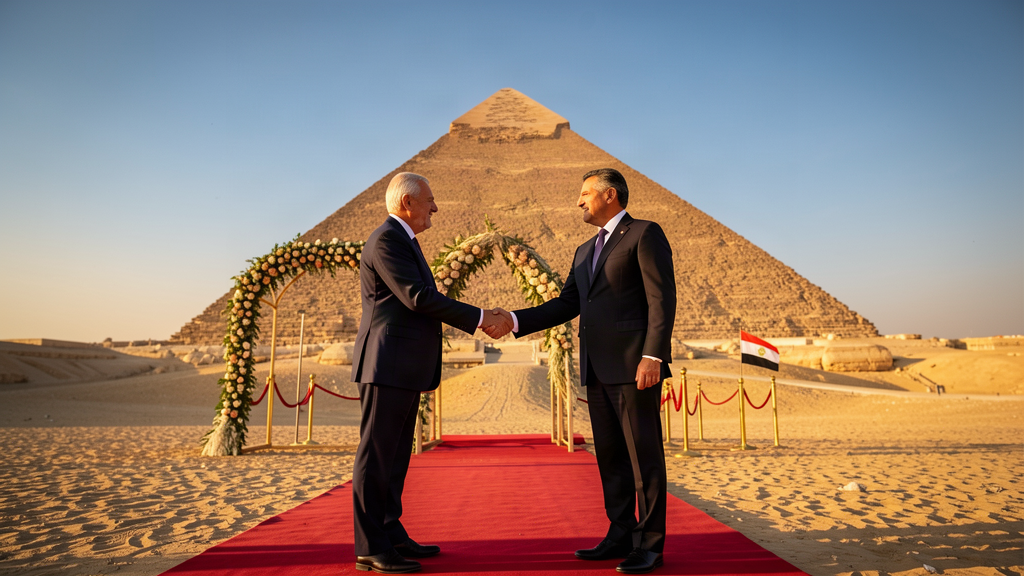
CAIRO, EGYPT — For a decade, the People’s Republic of China did not send its president to Egypt. On Tuesday, it finally did, and the trip is being described by observers as “the calmest thing happening in the Middle East right now.”
Chinese President Xi Jinping touched down in Cairo for the first visit in ten years, a milestone Al Jazeera noted marks the seventieth anniversary of diplomatic ties between the two countries. The official purpose is economic: trade talks, infrastructure, and a long list of memoranda of understanding. The unofficial purpose, as NPR put it, is a little harder to put in a press release.
“China’s growing ambitions at a time when U.S. influence has been weakened by its war in Iran,” the outlet wrote. In other words: the United States, which has spent six months in an intermittent war with Iran and cannot, as one senior administration official told reporters this week, “put a number on when it’s done,” has opened up a diplomatic lane that the world’s second-largest economy is now walking through at a strolling pace.
The contrast is the story. The U.S. is in the region as a military power that has been in the region, on and off, for the better part of a century. China is in the region as a customer. It buys oil, it builds ports, it signs frameworks. It does not, at present, have a carrier strike group anchored in the Gulf. It does, however, have a president who has not been to Egypt in ten years and is now, for the first time in a decade, standing in front of the Pyramids shaking hands with a head of state who has spent the last six months talking to American generals.
THE CAIRO ITINERARY: A GLANCE
- Day one: Arrival at Cairo International Airport; a photo op with President el-Sisi; a small but pointed nod to the seventy-year anniversary.
- Day two: Bilateral talks; a joint statement; a signing ceremony that will produce at least three memoranda and at least one phrase in both Mandarin and Arabic.
- Day three: A tour of a Suez Canal-side project; a press question about the U.S.-Iran war; a non-answer that will be quoted in Beijing for a decade.
- Day four: Departure. A statement of "deep appreciation." A return to a country that has, unlike the United States, no open-ended conflict on its hands.
Egypt, for its part, has been managing a delicate diplomatic dance for months. It sits on the Suez Canal, which means it is a transit point for roughly a tenth of the world’s trade. It sits in the Middle East, which means it is also, at this moment, a transit point for a great deal of American military planning. Cairo has been taking calls from both Washington and Beijing, and it has been, by all accounts, very polite to both.
The United States, which has been in the region long enough to have a full set of regional experts, a rotating set of generals, and a standing list of things that are “not going well,” has been trying to figure out what to do with the fact that its most important regional partner is now having a very good week with its most important economic rival.
At press time, the joint statement had not been released, and the U.S. State Department had not commented on whether it would be “monitoring the visit” or “noting the visit” or, as one senior official put it, “filing it under ‘things that are happening in the region that we are aware of.’”