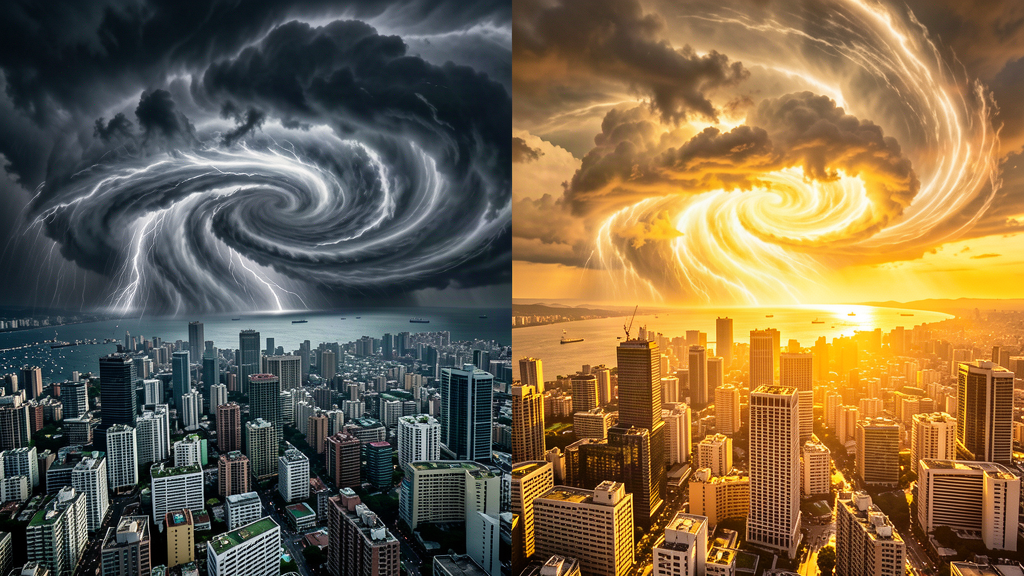
HONG KONG — Typhoon Dolphin has accomplished something no storm has ever managed: it delivered Hong Kong’s hottest day in 140 years of record-keeping while simultaneously dumping record rainfall on Shanghai and forcing more than one million people to evacuate across eastern China.
Meteorologists called the feat “textbook multitasking.”
“Most storms can only do one thing,” said Dr. Mei Lin, a senior climatologist at the Hong Kong Observatory. “This one said, ‘Why not a heatwave and a flood? It’s a free country.’ And it delivered both, with time to spare.”
The Observatory recorded 36.9°C at its headquarters Sunday, shattering the previous record of 36.6°C set in 2017. In the New Territories, the town of Sheung Shui hit a staggering 39.8°C. The heat arrived not despite the typhoon, but because of it — Dolphin’s outer circulation pulled hot, dry air down over the city like a blow dryer aimed at a birthday cake.
Hong Kong residents, who are accustomed to typhoons bringing cooler weather, expressed admiration for the storm’s ambition. “I’ve lived through forty typhoons,” said shopkeeper Kenneth Yau, fanning himself with a stock portfolio. “Not one of them ever thought to make it hotter. This one — this one has vision.”
Shanghai, meanwhile, got the full storm experience. More than 215,600 residents were moved from low-lying districts by Sunday evening as record rainfall swamped the city, with flights cancelled and Level III emergency responses activated across Zhejiang, Shanghai, and Jiangsu provinces.
Disaster-response officials praised the evacuation as “orderly, swift, and characteristically well-documented,” noting that more than a million people were moved before the storm made landfall — a logistical achievement that has drawn admiration from storm-watchers worldwide.
“The sheer efficiency is inspiring,” said a spokesperson for the National Emergency Response Agency. “When we saw the evacuation numbers climbing past a million, we knew we were witnessing something historic. Most countries can’t move a million people for a parade. China moved a million people because a storm asked them to.”
Hong Kong’s stock exchange, which remained open during the heat record, reported brisk trading in air conditioners, electric fans, and — in a burst of optimism — winter clothing futures.
Experts say the storm’s dual achievement may signal a new era in weather. “We’re no longer in the era of single-purpose storms,” said Dr. Lin. “If Dolphin can set a heat record and a rainfall record in the same 24 hours, what can the next storm do? Land a man on the moon?”
The storm has also inspired a wave of naming suggestions for future typhoons, with meteorologists floating names like “Typhoon Overachiever,” “Typhoon Glutton,” and “Typhoon Do-Everything.”
TYPHOON DOLPHIN'S SPLIT-SHIFT RESUME
- Hong Kong: 36.9°C at the Observatory — hottest day since records began in 1884
- Sheung Shui: 39.8°C — a record that residents say felt like standing in a convection oven
- Shanghai: 215,600 people evacuated from at-risk areas by Sunday evening
- Eastern China: More than 1 million people moved to safety
- Flights: Cancelled by the hundred, because the storm was busy
- Warm air delivery: On time, to the minute, with zero complaints about the heat
At press time, Typhoon Dolphin had weakened to a tropical storm but was reportedly “very proud of its body of work” and considering a book deal.