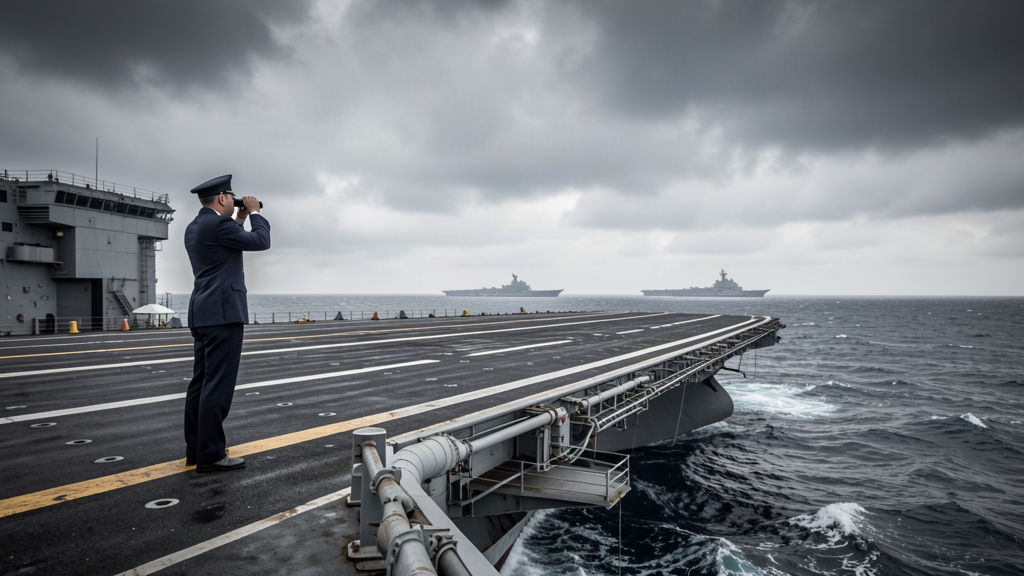
SAN DIEGO — The USS Abraham Lincoln has now been at sea for 265 days, and the United States Navy has finally sent a replacement — a fact the Navy announced with the enthusiasm of a parent telling a teenager that curfew is ten.
The USS George Washington, carrying roughly 5,000 sailors, has begun its transit to the Middle East to relieve the Lincoln, whose crew arrived in the region in January, before the war with Iran began. The sailors have been aboard since the war started, and they will now remain aboard for the additional weeks it takes the George Washington to arrive — a window the Navy has declined to shorten, citing operational security, which is the Navy’s word for “we are counting the days, and so are you.”
The conditions that prompted the relief have been documented in reports from sailors and their families that the administration has pushed back against, and that include, in at least one case, a sailor jumping overboard. On Friday, asked whether the deployment had gone on too long, President Trump said, no — not nearly long enough.
The president added, in a statement released with the timing of a man who has decided what he is going to say, that he has “more respect and gratitude for those sailors than anybody,” and that “what they do in those high seas in those austere conditions with less port calls — it’s incredible.” We want to be clear about what that sentence is: it is true, and it is also, like many things in Washington, a sentence that contains the entire problem.
Adm. Brad Cooper, the head of U.S. Central Command, wrapped up a tour of the region Saturday that included a visit to the Lincoln. He described the deployment as “one of the most operationally intense and consequential of the modern era” and praised the crew’s “camaraderie, teamwork and resilience.” Those are the right words. They are also, we are told, the words the Navy uses when the alternative is a word that ends in “ed” and has four letters.
At an August 6 town hall at Naval Air Station North Island, Acting Navy Secretary Hung Cao told roughly 200 family members that a relief strike group was being prepared, and declined to give a return date for the Lincoln, also citing operational security, which at a town hall full of mothers is a phrase with a different ring to it. The families’ comments, posted online and read with the care they deserve, ran the full spectrum of the situation: “Can’t wait for them to return home,” wrote one. Another wrote about the food, which, in the economy of a 265-day deployment, is the only budget line a mother can audit.
An expert on the Navy’s suicide cluster of 2022 and 2023, who was in charge of the service’s response, put the administrative version of the problem plainly: dismissing sailors’ concerns “is not one comment. It’s creating an ambient environment of disrespect.” She noted that sailors may not recognize the impact of constant stress until months after a deployment is over, which is the way with that kind of thing — it does not show up on the manifest. It shows up later, in a different port.
There is a version of this story in which the Navy is praised for listening, and we are including it, because it is true: the relief is real, the transit has begun, and the George Washington is, in every sense that matters, on the way. There is also a version of this story in which the most powerful man in the country is asked whether a 265-day deployment is too long, and answers the way a man answers when the answer would cost him something: no. Not nearly long enough.
THE LINCOLN DEPLOYMENT, BY THE NUMBERS
- Days at sea: 265, and counting.
- Arrival in region: January, before the war began.
- Relief force: USS George Washington strike group, ~5,000 sailors.
- Estimated return date: "Operationally sensitive."
- Sailors' verdict, per one family: "give them a decent meal."
At press time, the George Washington was somewhere in the Indian Ocean, the Lincoln’s count had reached 266, and the Navy had begun accepting applications for what one recruiting poster calls “a career that will change your life,” without specifying which part of the life, or in which direction.