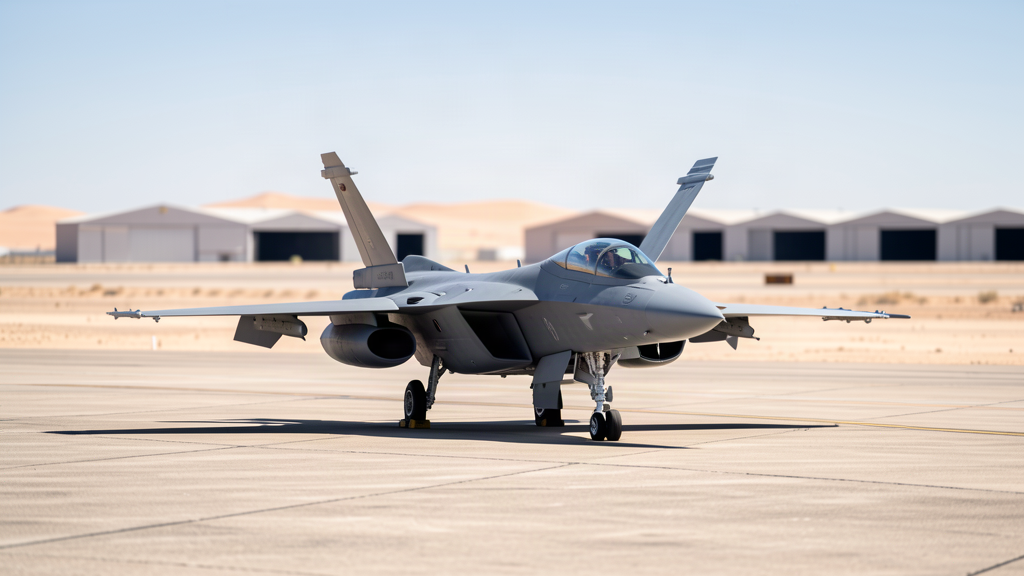
ABU DHABI, United Arab Emirates — In a landmark moment for Gulf airpower, South Korea has moved to sell the United Arab Emirates not merely a fighter jet, but an entire aerospace relationship — joint development, local production, and a share of future KF-21 exports, a package Defense officials are describing in terms that make “deal” sound almost quaint. The only sticking point, as analysts have quickly noted, is the engine.
The KF-21 Boramae, a fourth-and-a-half-generation fighter developed by South Korea’s Korean Aerospace Industries, has been the centerpiece of a multi-year courtship. The two nations signed a letter of intent to cooperate on the program last spring, and the partnership has since ballooned into a target worth an estimated fifteen billion dollars. The Emiratis, for their part, have made clear they do not want to be mere buyers. As one statement put it, the deal is to “move beyond a simple export-purchase structure” and pursue “the UAE’s independent operational capability,” according to The Defense Post.
Here is where the geometry of the deal gets interesting. The KF-21’s engine — the part of a fighter jet that, in a very real and non-negotiable sense, is the fighter jet — is American-controlled. The result is a transaction that defense analysts have taken to calling, with the affectionate brevity of the trade press, “a plane with a locked door.” The UAE can fly it, admire it, and display it at airshows. Whether it can service it, modify it, or keep it flying after a parts embargo is a question the contract is, as one analyst put it, “carefully structured to leave open.”
THE KF-21 DEAL, AT A GLANCE
- What the UAE is buying: A fighter jet, plus a relationship
- What the relationship includes: Joint development, local production, export shares
- What the engine is: American-controlled
- What "independent operational capability" means: To be negotiated
- Estimated value: $15 billion, give or take the engine
The irony is not lost on observers, though it is not, precisely, a joke. A nation paying fifteen billion dollars for “independence” is, in the technical sense, purchasing the aesthetic of independence — the hangar, the tail number, the photo op — while the one component that actually makes the machine a machine remains, in the words of one Gulf defense official, “a friend’s.”
South Korea, for its part, is selling what it has. The program is mature; twenty additional jets were contracted domestically earlier this year, a sign, as the trade press puts it, that the machine works. What it cannot yet sell, on its own terms, is the freedom from the machine. The Emiratis, to their credit, appear to have priced this in. They are, as one regional analyst observed, “very comfortable with a jet they can fly but not own.” It is, in the end, the same arrangement that has governed so much of the modern arms trade: you buy the capability, and you rent the sovereignty.
At press time, the deal’s engineers had announced a joint workshop on “technical autonomy,” scheduled for a date to be determined, in a location to be determined, in a language to be determined.