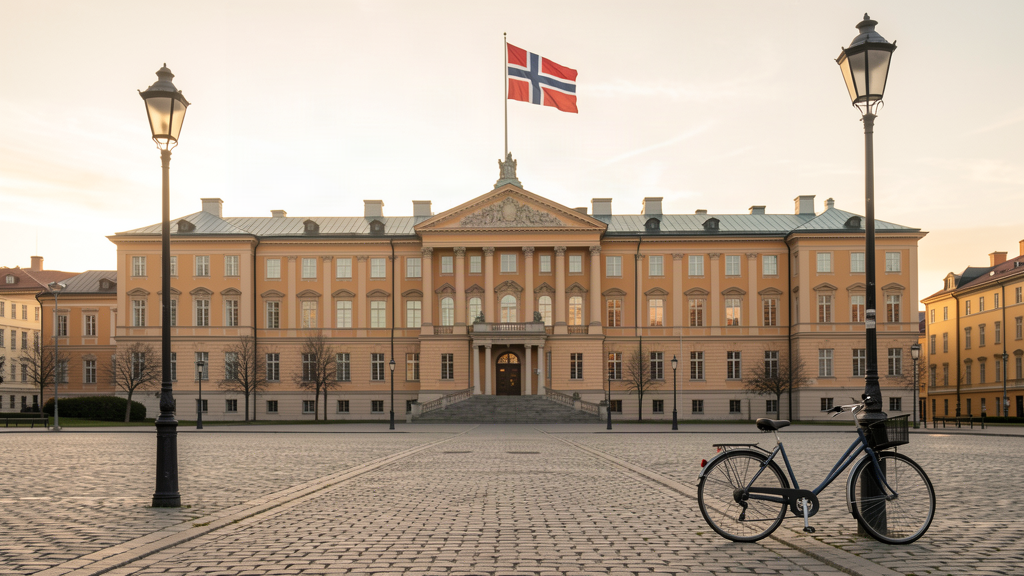
OSLO, NORWAY — Norway on Friday lost its king, and in the same breath gained its next one, in the only succession ceremony in the Western world that requires no plane, no limousine, and no press conference, because the country had simply been practicing for a quarter century.
King Harald V died on Friday at 89, ending a reign that began in 1991 and had, by this week, made him Europe’s oldest reigning monarch. Under the Norwegian constitution, the crown passes immediately upon the death of the reigning monarch. The new king, Haakon VIII, was already in the country, already in the job’s orbit, and, per the palace, “informed of the news with the calm he would have brought to it.” The transition took approximately the amount of time it took for the first royal statement to be typed.
Harald’s path to the throne had its own transition problem, and he solved it in 1941. As a child, he fled the Nazi occupation of Norway with his mother, Princess Märtha, and went into exile in the United States, where a 9-year-old Harald told a crowd in New York that he was, as he would be remembered saying, “a small boy, but also a king,” a line he has been managing ever since. He returned in 1945, became king in 1991, and spent the next 35 years performing the duties of the crown with the kind of understatement that the rest of Europe has spent decades trying to copy and failing.
The man taking over is, by the standards of European royalty, a résumé. King Haakon studied law at Oxford, practiced as a lawyer for roughly a decade, played handball for Norway, and has been crown prince since 2001. He and Queen Mette-Marit have two children, Princess Ingrid Alexandra and Prince Sverre Magnus. He has been, in the words of one Oslo-based political scientist, “the only person in the country who has ever been both a practicing attorney and the designated backup to a monarch, and he did not seem to find this strange.”
The immediate schedule, such as it is, consists of a statement from the palace, the flag going to half-mast, and the nation entering the formal mourning period. The government has announced that the day’s other business will proceed, which is the correct response, because the other business is the country, and the country does not close. The royal family’s next public appearance will be arranged “in due course,” a phrase the Norwegian government has used so many times that it has its own postal code.
THE SUCCESSION, AT A GLANCE
- Time of transition: Instantaneous. The constitution does not offer a waiting period, and the constitution is not known to negotiate.
- Ceremony required: None. The flag is lowered. The statement is issued. The country goes back to the weather.
- New monarch's credentials: Law degree, roughly a decade of practice, one handball career, and 25 years of being the second most important person in Norway, which is a longer apprenticeship than most jobs offer.
- Predecessor's career: One exile as a child, one war, one 35-year reign, and a public record of never once making the transition sound difficult.
Norway, which has been a constitutional monarchy since 1814 and has had exactly one interruption, in 1940, and resolved that one by sending a 9-year-old to New York, does not appear to be experiencing a moment of institutional doubt. The Storting’s speakers from all parties have issued statements of “deep sorrow and great pride,” which is the standard pairing, and the standard is holding.
At press time, the palace had not announced the date of the late king’s funeral, and the country had not, to anyone’s knowledge, begun arguing about it, which is how Norway does everything. The new king has already been briefed, per the palace, and has, per the same source, “the situation under control,” a phrase that would mean less in English than it does in a country where a man can spend ten years as a lawyer and another 25 as a prince and still be considered the most relaxed person in the room.