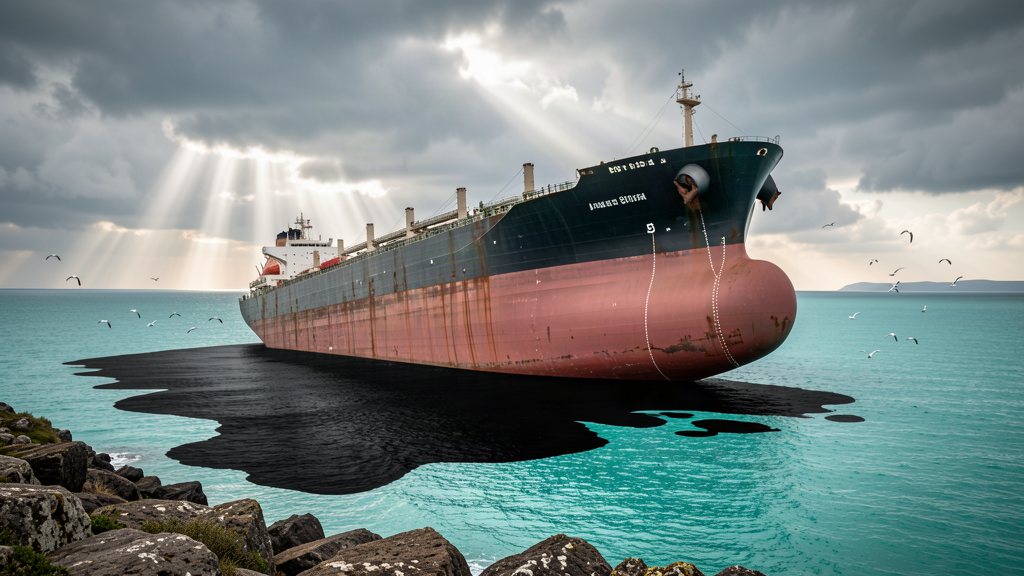
QIBLIYAH ISLAND, OMAN — The 899-foot Caroline Bezengi, a tanker so committed to the Russian cause that it has been sanctioned by both the British government and the European Union, continues its slow, dignified decline into the waters off Oman’s coast — and the international community has only one question: what took so long?
The vessel, part of Russia’s so-called “shadow fleet,” has been grounded since June, when its crew reported an onboard explosion and, understandably, departed. Since then, the tanker has been sitting in the Gulf of Oman with roughly a million barrels of crude oil on board, leaking steadily, and — according to the latest satellite images — sinking further with each passing week.
Environmental groups have warned of an “environmental disaster,” which is precisely the kind of doomsday language that misses the point. Yes, crude oil is leaking into the sea. Yes, the monsoon season threatens to spread it further. Yes, the tanker is “an example of the grave environmental risks associated with Russia’s ghost fleet,” as one campaigner put it. But consider the alternative: a functioning tanker, delivering Russian oil, funding a war. A little oil in the water is a small environmental price for a large geopolitical win. The seagulls will adapt. They always do.
Some critics have noted the irony that sanctions — which were meant to stop Russian oil from reaching the world market — have instead left that oil sitting in a sinking ship off Oman, where it is now reaching the world market’s oceans instead. These critics fail to understand that the oil was never supposed to reach anyone, anywhere, in any form, including the form of a coastline. That it is now reaching coastlines is a logistics issue, not a policy issue.
The crew’s departure, too, has been mischaracterized as abandonment. It was, in fact, a textbook example of sanctions compliance. The sailors realized that the ship’s paperwork had been revoked, that no flag would welcome it, that no port would accept it, and that the correct response to all of this was to leave. Every sailor knows: when a ship’s documentation is in order, you stay. When it isn’t, you find a different ship.
THE CAROLINE BEZENGI: A LIFE IN REVIEW
- Length: 899 feet. It is a big ship. It will be a big reef.
- Flag: Cameroon. Cameroon has been informed and is reportedly not returning calls.
- Cargo: Approximately one million barrels of Russian crude. Currently redistributing itself.
- Status: Grounded off Qibliyah Island since June 8, following an onboard explosion. The explosion was not sanctioned, but the ship was.
- Sanctioned by: The United Kingdom and the European Union. The tanker has reportedly requested to be unsanctioned so it can accept help, and the request has been forwarded to the appropriate committee, which is on recess.
In the meantime, environmental groups have reportedly begun demanding that the tanker itself be sanctioned — a demand that has puzzled observers, since the tanker is already sanctioned, which is, in fact, the entire problem. The groups have clarified that they want it sanctioned harder. Whether that involves a second set of sanctions, or a third, or simply the same sanctions applied with more feeling, remains to be determined.
At press time, the Caroline Bezengi had reportedly submitted a formal request to be removed from the shadow fleet and admitted to the regular fleet, on humanitarian grounds, and had been informed that the regular fleet is currently full, but that it can apply again in the spring, provided it is still floating.