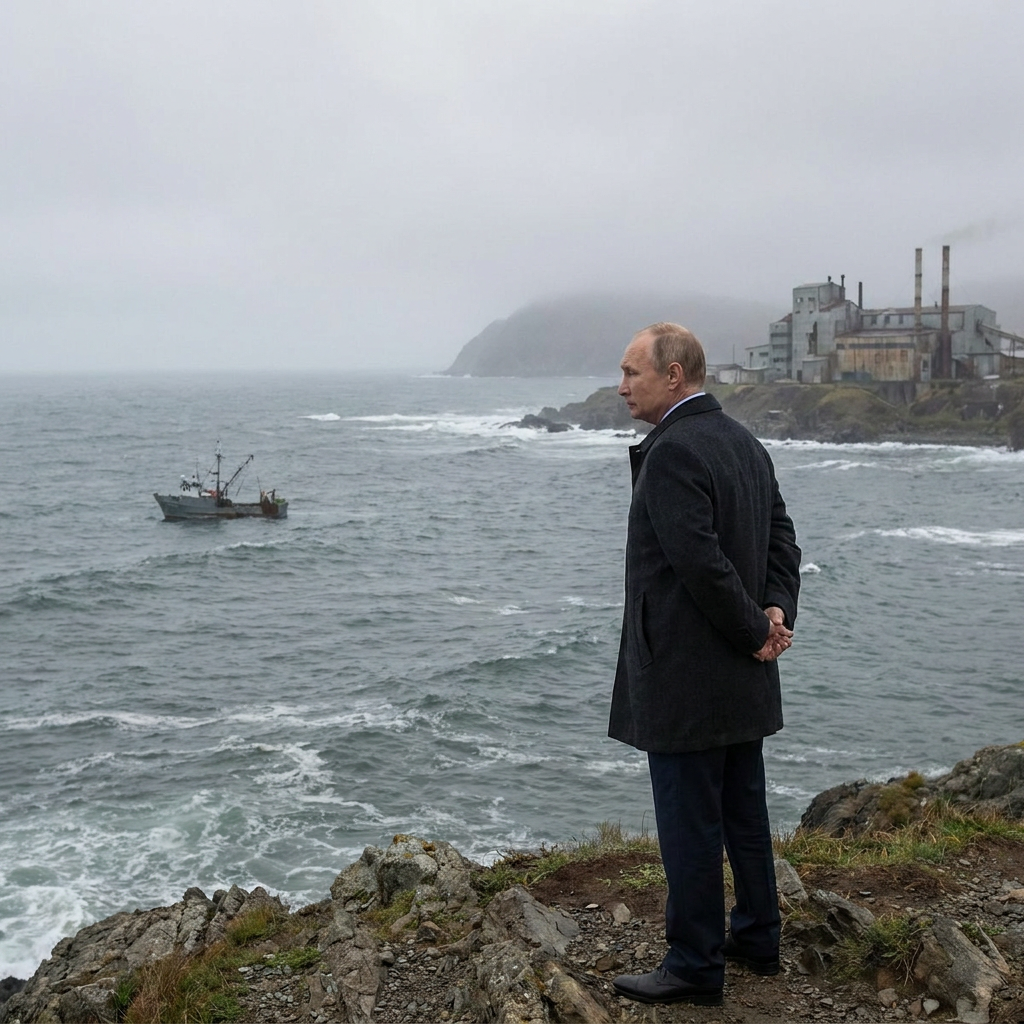
ITURUP ISLAND, RUSSIA — In a bold act of diplomatic tourism, Russian President Vladimir Putin has made the first visit of his life to the disputed Kuril Islands, the windswept Pacific chain that Japan calls the Northern Territories, Russia calls the Southern Kurils, and everyone else calls the reason these two countries don’t get to have nice things.
The islands have been the subject of an unresolved territorial dispute since the Soviet Union seized them in the closing days of the Second World War. For eight decades, diplomats have tried to resolve the disagreement through negotiations, summits, and carefully worded joint statements. President Putin, a man who respects results, decided to try a new approach: showing up.
Japanese Prime Minister Sanae Takaichi called the visit “absolutely unacceptable” and said it is “incompatible with the Japanese position on the Northern Territories.” Foreign Minister Toshimitsu Motegi, for his part, summoned Russia’s ambassador for what officials described as a frank exchange of views, in which one side did most of the viewing.
The visit’s centerpiece was a tour of the Yasny fish processing complex on Iturup, where the president reportedly inspected the filleting line with the careful attention of a man who understands that, in the Pacific, fish is power. Russian state media described the trip as a routine working visit. Japanese state media described it as an act of aggression that smells faintly of salmon.
“The President has been criticized by some for visiting a territory Japan considers its own,” said a Russian official traveling with the delegation, who asked not to be identified because he was not authorized to discuss vacation planning. “These critics fail to understand a basic principle of Russian foreign policy: you cannot dispute an island you have personally visited. That would be rude.”
THE ITURUP ITINERARY: A DAY OF DIPLOMACY
- 9:00 a.m. — Arrival at Yasny fish processing complex; formal inspection of the filleting line.
- 10:30 a.m. — Photo opportunity with the Pacific Ocean; oceans declined to comment.
- 12:00 p.m. — Working lunch of locally caught salmon; salmon reportedly unaware of the diplomatic stakes.
- 2:00 p.m. — Walk along the shoreline; Japanese protest note delivered to delegation's hotel desk.
- 4:00 p.m. — Departure; islands left exactly where they were, which is the problem.
The timing was not lost on Tokyo. The visit came shortly after Japan published its 2026 defense white paper, a document that presumably contains a chapter on how to respond when a neighboring leader decides to go sightseeing in contested territory. Japan has now reportedly dispatched its ambassador to stand outside the fish plant with a strongly worded note and a small souvenir.
Some say a leader visiting disputed territory is a provocation. Others say a leader visiting disputed territory is merely exercising his right to tourism. The truth, as always, lies somewhere in the middle of the Sea of Okhotsk.
At press time, Japan was reportedly preparing to respond by scheduling an official visit of its own — to a contested island of its choosing, ideally one with good weather and a functioning resort.