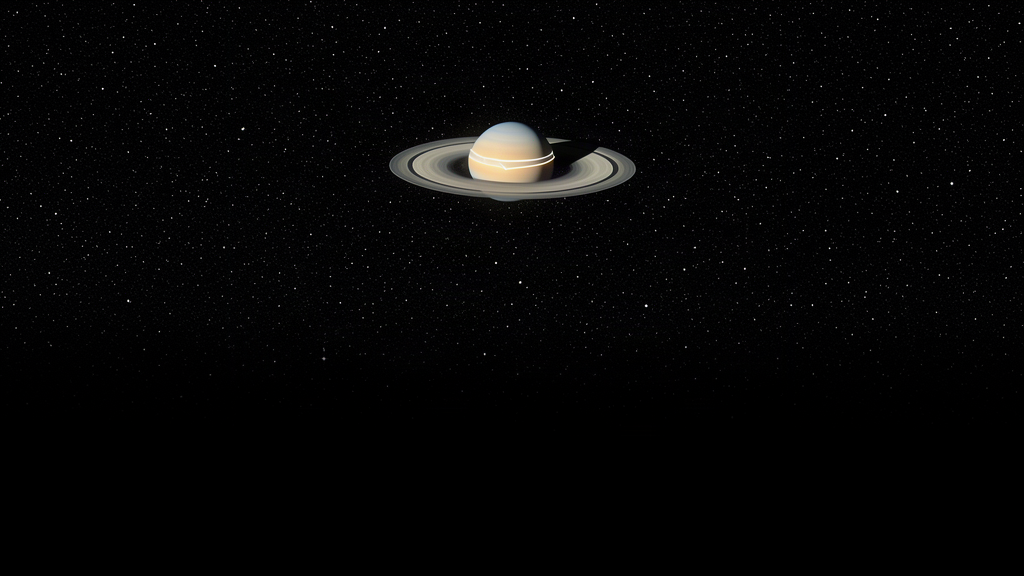
WASHINGTON — Scientists using NASA’s Hubble Space Telescope have found a giant ten-sided wave circling the south pole of Saturn, which is the way a planet announces it is, in the specific, going to be geometric, and the discovery, per the researchers, is the first time a regular-sided pattern has been seen in the planet’s southern hemisphere.
The shape is a decagon, which is the word for a thing with ten sides, and the thing in question is a band of atmosphere, and the band is, in the specific, moving on its own, and the moving is, in the specific, independent of the rest of the sky it is in. The work, per the NASA account, was reported this week in Science Advances, and the decagon was, in the specific, first spotted by Hubble in 2023, which is the way a shape is found, and then, in the specific, found again, and then, in the specific, explained.
The part of the story that belongs in the first paragraph is the hexagon, because Saturn already has one. At the north pole, the planet has, for decades, had a six-sided storm that has been, in the specific, one of the most famous shapes in the solar system, and the shape has, in the specific, been described as extraordinary, and the word extraordinary is the word scientists use when they mean the thing should not be, in the specific, a thing.
The decagon changes the word. If one pole can be a hexagon, and the other pole is a decagon, then the planet is, in the specific, a thing that makes sides, and the sides are, in the specific, a thing the planet does, and the doing is, in the specific, the part that the researchers are, in the specific, now working on. The hexagon, per the scientists, is not, in the specific, as extraordinary as it was, because extraordinary things are, in the specific, the things that happen once, and this is, in the specific, the second one.
THE DECAGON, AT A GLANCE
- What: a 10-sided atmospheric wave
- Where: Saturn's south pole
- Seen with: the Hubble Space Telescope
- First spotted: 2023
- Reported: September 2, 2026, in Science Advances
- The other shape: the hexagon, at the north pole
- Effect: the hexagon is now "not as extraordinary"
The practical effect of a second geometric storm is that the study of the first one is, in the specific, easier, because a thing that happens once is, in the specific, hard to explain, and a thing that happens twice is, in the specific, a pattern, and a pattern is, in the specific, a thing with a cause, and the cause is, in the specific, the part the researchers are, in the specific, after.
At press time, the scientists said the work was “ongoing,” which is the way a team tells the public it has, in the specific, a shape, and that the shape has, in the specific, ten sides, and that the ten sides are, in the specific, still ten.