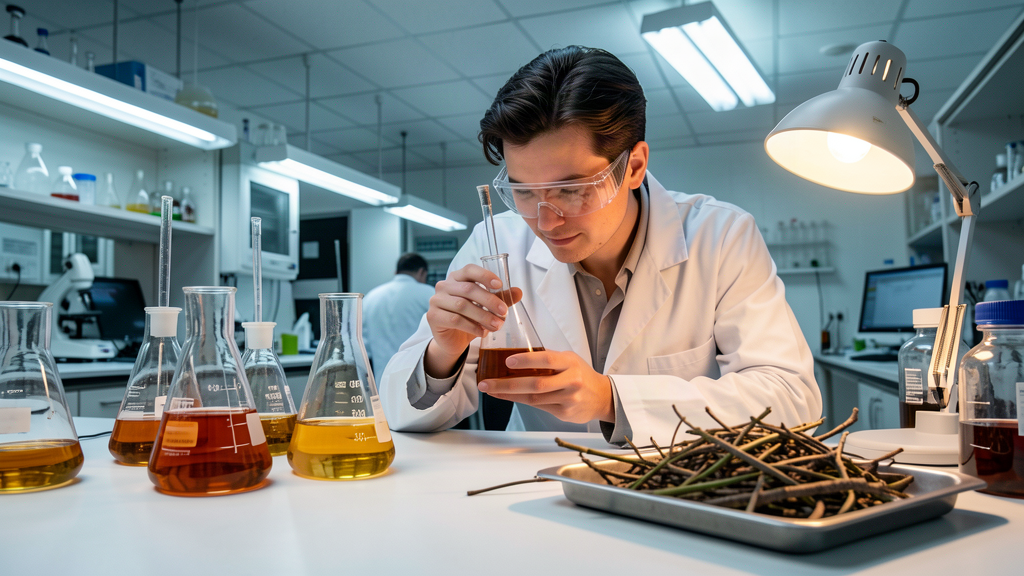
CAMBRIDGE, Mass. — For four hundred million years, lignin has been doing one thing, and it has been doing it without interruption, without a break, without so much as a public apology: it has been holding trees together. The molecule — a tangled, chaotic polymer that plants invented to make their own bodies structurally sound — is also the reason your cardboard box takes six weeks to decompose, the reason the paper mill has been running on a chemical budget since the 1870s, and the reason every green-chemistry lab on earth has spent the last two decades trying, one catalyst at a time, to ask it nicely to stop.
This week, according to a newly published study summarized on ScienceDaily, scientists did the asking. They developed a highly efficient catalyst that breaks down lignin — the stubborn backbone of plant waste — into useful chemicals under conditions that the previous generation of catalysts would have described, in the technical language of the field, as “relatively mild,” and, in the language of every process engineer who has ever stared at a reactor full of wood pulp, as “what the actual heck.”
The study’s second achievement is the one that matters more, and it is the kind of achievement that makes a chemist weep into their safety glasses: by revealing exactly how the catalyst works at the atomic level, the team has produced, in effect, a map of the molecule’s breakdown. Lignin has long been described in the literature as a “chaotic polymer,” which is a term of endearment in biochemistry, and it has meant, in practice, that every catalyst built for it was built in the dark — a key shaped to fit a lock no one had ever seen the inside of. The new work shows the inside of the lock. It shows which bonds the catalyst finds first, which fragments fall away in which order, and why the mild conditions are enough to make the whole structure let go.
The practical stakes are not small. Lignin is the second-most-abundant organic polymer on the planet, sitting in everything from newspaper to rice husks to the discarded stalks of corn, and it has historically been a problem rather than a resource — the thing that had to be burned, buried, or chemically tortured out of the way so the cellulose could be used. A catalyst that cracks it into useful chemicals under mild conditions does not merely solve a decomposition problem. It converts the waste stream of the entire global paper, packaging, and agricultural industry into a feedstock, which is to say: it takes the molecule that has been holding the world’s trees together for four centuries and, for the first time, holds a price tag.
The mild conditions are the part that the press releases lead with and the engineers nod at. “Mild,” in catalysis, is a word with a specific and unglamorous meaning: lower temperature, lower pressure, a solvent that does not require a hazmat team, a reaction that finishes in an afternoon rather than a weekend. Every degree of temperature the old process had to burn was a degree of energy cost, and every hour the old reaction ran was an hour of reactor time that could have been spent on the next batch. The new catalyst, the study reports, does the job in the time it used to take the old one to warm up.
THE LIGNIN RECORD: 400 MILLION YEARS OF REFUSALS
- ~400 million years: lignin's tenure as the structural backbone of land plants. It arrived with the first trees and has never once filed for leave.
- The 1870s: the paper industry's first serious attempt to chemically separate lignin from cellulose, which is how the world got sulfite mills and their distinctive smell.
- The last 20 years: a steady procession of catalysts, each one a key built in the dark, each one working the lock a little better and asking a little less violence.
- This week: a catalyst that breaks lignin down into useful chemicals under relatively mild conditions — and, for the first time, an atomic-level map of exactly how it does it.
- The next step: scaling. The molecule has held trees together at industrial scale since the Carboniferous. The question is whether it will hold up, as a feedstock, at industrial scale too.
There is a tradition, in the green-chemistry community, of announcing the “death” of lignin at roughly the frequency of the molecule’s own publication record, and each such announcement has been, as of this week, premature — not because lignin refused to die, but because the conditions of its death were not mild enough to be worth the funeral. The study’s contribution is to make the funeral affordable. It is the difference between a molecule that can be broken down in principle, in a lab, at 250 degrees and four atmospheres, and a molecule that can be broken down on a Tuesday, in a reactor that a normal facility can actually operate, at conditions that do not require a special permit for the temperature alone.
At press time, the team was preparing to file the catalyst’s design details, which, once published, will start the next round of the field’s long game: every other group in the world, looking at the map of the lock, deciding which key they would like to try first. Lignin, for its part, has no comment. It has been holding things together for four hundred million years. It has never once been asked.