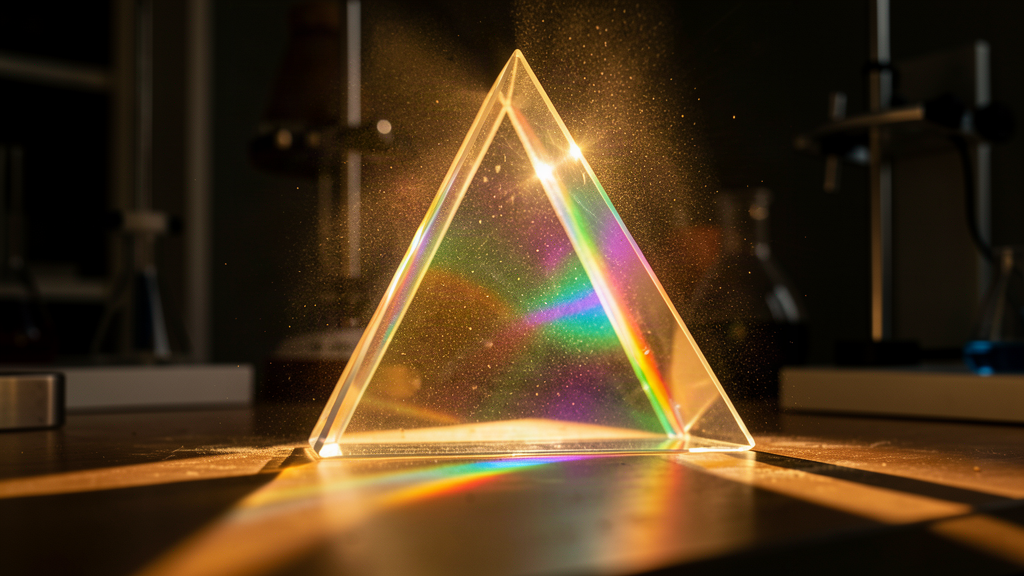
OTTAWA, Canada — Physicists at the University of Ottawa and the Max Planck Institute for the Science of Light have achieved something that many in the field considered impossible: they generated quantum-entangled photon pairs directly from sunlight, without lasers.
The result, published in the journal Optica, means that the sun — a nuclear furnace 93 million miles away that has been doing quantum physics in the background since before life existed on Earth — has finally been recognized for its contributions to the field. Scientists estimate the sun has been producing entangled photons for approximately 4.6 billion years. Nobody asked. Nobody noticed. The sun did it anyway.
The experiment, conducted over three days of outdoor testing, produced entangled photon pairs with a fidelity of roughly 94 percent — slightly below the quality of laser-driven sources but well within the range that physicists describe as “actually working, which is more than we expected.” The team also violated Bell’s inequality, a statistical test that confirms quantum behavior is real and not just the result of some deeply hidden variable that nobody has thought of yet.
The achievement challenges a long-held assumption in quantum optics: that the incoherence of sunlight — its scattered wavelengths, its inconsistency, its tendency to be blocked by clouds — made it fundamentally unsuitable for generating entanglement. “Everyone assumed sunlight was too messy,” said Dr. Li, the lead author on the paper. “But it turns out that with the right optical setup, even messy light can produce clean quantum states. It’s like finding a straight line in a Jackson Pollock painting.”
QUANTUM ENTANGLEMENT VIA SUNLIGHT: THE DETAILS
- 94% — fidelity of entangled photon pairs from sunlight
- 4.6 billion years — how long the sun has been doing this without credit
- 3 — number of outdoor testing days required
- 0 — number of lasers used
- 1 — number of physicists who now feel "a little foolish"
- ∞ — estimated number of entangled photons the sun produces daily
The practical implications are significant. Quantum technology — including quantum computing, quantum cryptography, and quantum communication — currently depends on expensive, energy-intensive laser systems to produce entangled photons. If sunlight can do the same job, even at slightly lower fidelity, it opens the door to solar-powered quantum devices that could operate anywhere the sun shines.
“Imagine a quantum communication node in rural India, or a quantum sensor in sub-Saharan Africa,” said Dr. Priya Mehta, a quantum physicist at MIT who was not involved in the study. “You don’t need a laser lab. You don’t even need reliable electricity. You need a sunny day and a really good lens.”
The research team is already planning follow-up experiments. They want to test whether the entanglement quality can be improved with better optical components — a goal they describe as “engineering the sun into a better quantum光源,” which is a sentence that would have been incomprehensible five years ago and is now just regular science.
The sun, for its part, has not commented on its newfound role in quantum physics. Scientists say this is consistent with its behavior over the last 4.6 billion years: doing extraordinary things, telling no one, and waiting for humans to eventually notice.
At press time, the sun was reportedly “still doing quantum entanglement” and was “not available for comment” because it is a star.