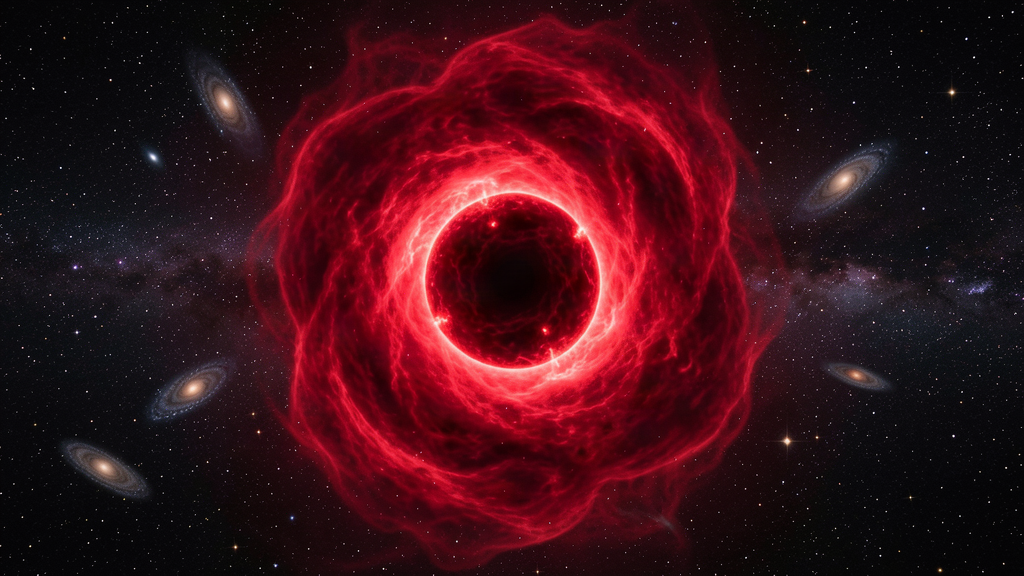
CAMBRIDGE, MA — For millions of years, a black hole in the early universe wanted nothing more than to be a star. It wanted it so badly that it wrapped itself in a cocoon of hydrogen roughly the size of our solar system, learned to glow a brilliant red, and posed as one of the brightest objects in the sky. This week, astronomers announced they have finally caught it.
The object, dubbed MoM-BH*-1, was identified in data from the James Webb Space Telescope and is believed to be a black hole about 100,000 times the mass of the sun, surrounded by a dense, star-like cocoon of hydrogen that makes it shine roughly 100 billion times brighter than an ordinary star. Researchers at MIT and elsewhere say the object represents a brand-new class of astrophysical phenomena — a “black hole star” — and may help explain the mysterious “little red dots” that have puzzled astronomers since 2024.
The physics, as described in the research published this month, is almost absurdly theatrical. A black hole — an object defined by its refusal to let anything escape — is somehow emitting light from a dense shell of hydrogen wrapped around it like a winter coat. The hydrogen cocoon is roughly the size of our solar system. The glow is unmistakably red. And the whole production has been running for over 13 billion years, which is longer than most Broadway shows, and with considerably better reviews.
Scientists believe the “star” may be an early stage in the life of what eventually becomes a supermassive black hole — the kind that now anchors galaxies like our own. In other words, what we are looking at is not a failure of physics but a developmental milestone: every galaxy’s central black hole apparently had a phase where it tried on a star costume, went to a few cosmic parties, and eventually took the costume off to become the serious, gravitationally dominant entity we know today.
THE METHOD ACTOR'S COSTUME BUDGET
- Costume: one cocoon of hydrogen, solar-system-sized, custom fit.
- Lighting: brilliant red, visible across the early universe.
- Performance length: 13+ billion years, and still going.
- Method: fully committed. No stunt double. No CGI.
- Critical reception: astronomers are calling it "the performance of a lifetime," and they mean that literally.
The discovery has already produced a wave of poetic comparisons in the scientific literature, with researchers describing the object as a key to understanding the little red dots that have haunted JWST data for two years. Some astronomers have even begun referring to the object as “the universe’s greatest impressionist” — a black hole that spent eons convincing telescopes that it was a star, only to be exposed by the very technology humanity built to look at things that pretend to be other things.
Some say a black hole that glows like a star is a contradiction in terms. Others say it is the most beautiful thing the James Webb Space Telescope has ever seen. The truth, as always, lies in a third position I just invented: if a black hole wants to be a star, who are we to judge? It is technically not emitting light from inside, it is merely wearing the light on the outside, and honestly, the effort is what matters.
At press time, astronomers were reportedly preparing a follow-up observation to determine whether the black hole will be upset when it learns it has been found out, and whether it will go through a “villain arc” and start eating nearby gas clouds out of spite.