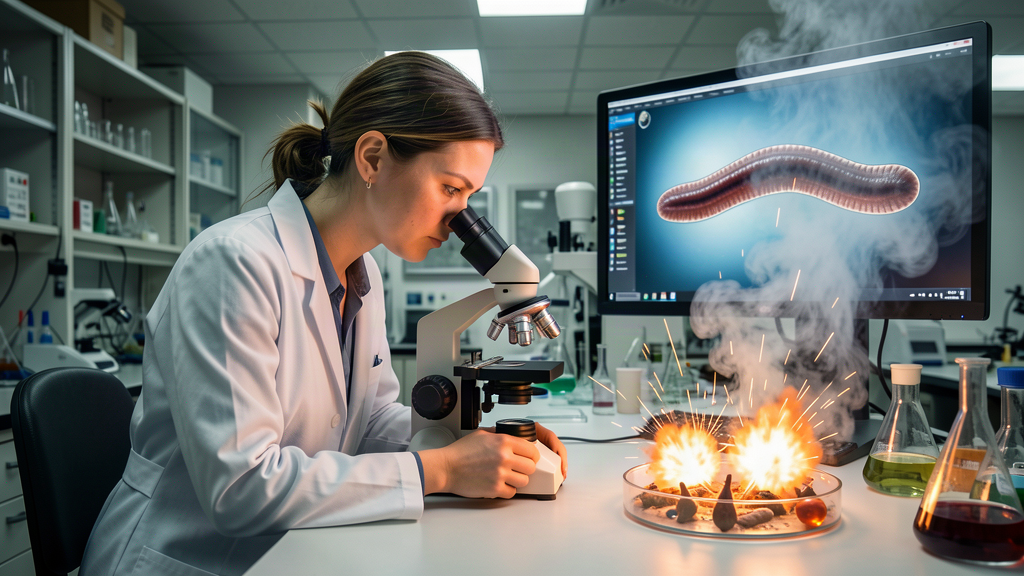
STANFORD, CA — Researchers at Stanford University have discovered a previously unknown type of immune cell in planarian flatworms that defeats threats by detonating itself, a cellular defense so complete that the cell vanishes within minutes, leaving no trace behind.
“It’s the most selfless thing I’ve ever seen at the microscopic level,” said Dr. Marisol Vega, the study’s lead author, describing what she called “ruptoblasts” — cells that detect a threat, rush toward it, explode, and take the enemy with them. “They don’t call for backup. They don’t file a report. They just go.”
The discovery, published by the Stanford team studying the flatworm’s famous regenerative abilities, has been hailed by observers in the defense community, several of whom are reportedly very interested in whether the mechanism can be adapted for human use. The answer, for now, is no — humans do not possess ruptoblasts — which the researchers describe as a gap in our national immune defense, and which the Pentagon describes as “a procurement opportunity.”
The cells are particularly remarkable because of what they give up. Unlike a normal immune cell, which lives to fight another day, a ruptoblast has exactly one career move. It is the cellular equivalent of a soldier who signs up for the mission, carries out the mission, and then evaporates with a job well done — no pension, no parade, no lifetime achievement award. Biologists call this “altruistic self-destruction.” The Freedom Eagle calls it leadership.
Researchers note the discovery could eventually inform new approaches to treating infections and inflammatory diseases — or, at minimum, provide a satisfying metaphor for anyone who has ever wanted to handle their own tax filing by detonating.
Ruptoblast Deployment Protocol (As Observed)
- 0:00 — Threat detected: The cell identifies bacteria or foreign cells nearby.
- 0:30 — Approach: The cell moves in. No warning. No negotiation. No paperwork.
- 1:15 — Detonation: The cell explodes, destroying nearby threats in a localized blast.
- 2:00 — Departure: The cell is gone. The bacteria are gone. The area is clean. No survivors, no witnesses, no review board.
- Ongoing: The flatworm, now slightly lighter, carries on with its day.
At press time, the Department of Defense was reportedly studying whether ruptoblasts could be trained to submit expense reports, and concluded that, no, on reflection, the vanishing thing was preferable.