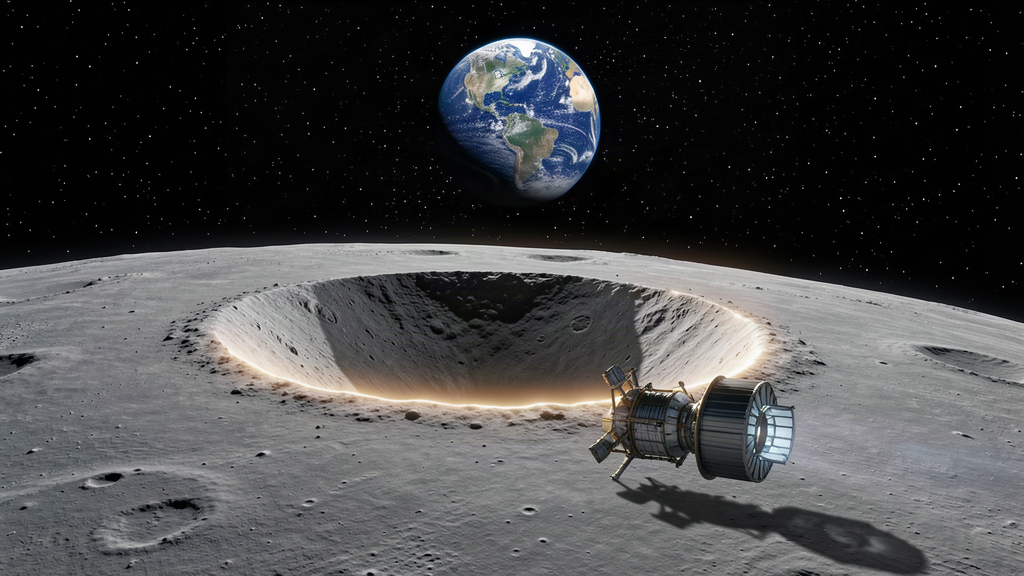
CAPE CANAVERAL, FL — In the early hours of Wednesday, a four-ton spent SpaceX Falcon 9 upper stage struck the Moon at roughly 5,400 miles per hour near Einstein Crater, carving out a crater 60 feet across and 12 feet deep.
No one saw it happen. NASA and SpaceX tracked the stage’s trajectory with the kind of precision that would make a guidance counselor weep, calculating a “100% chance of impacting the Moon” — and then, at the appointed hour, the impact occurred entirely out of view of Earth’s telescopes. It was, in other words, the most successful American lunar mission in years: flawless execution, zero witnesses.
To the cynical observer, a used rocket body crashing into the Moon is space junk. To the patriotic observer, it is a delivery. America has once again delivered something to the Moon — on time, at speed, and with no astronaut in danger. The fact that the delivery was a 13.8-meter metal tube that had spent seven months drifting through space is simply a matter of packaging.
The new crater sits in a prime location, adjacent to Einstein Crater, which means the Moon now has a neighborhood where genius meets American engineering. Scientists are said to be thrilled, or at least professionally curious. NASA had hoped to observe the impact directly using ground-based telescopes and space-based assets, but the stage declined to perform on cue — a trait it shares with every other rocket ever built.
The impact adds to a growing collection: human-made debris on the lunar surface now tops 209 tons, making the Moon, in a very real sense, the only celestial body whose real estate market is driven entirely by what we can throw at it. Every spacefaring nation has contributed, of course — but Wednesday’s crater is the newest, the freshest, and, at 60 feet across, the one with the most curb appeal.
MISSION PROFILE: 2025-010D
- Payload: One (1) spent Falcon 9 upper stage, 4 metric tons, no crew, no science instruments, no snacks.
- Velocity at impact: 5,400 mph. The Moon did not have time to object.
- Crater produced: 60 feet across, 12 feet deep. The Moon's newest American landmark, viewable from lunar orbit and, with a good telescope, from your patio.
- Witnesses: None. NASA attempted observation; the stage arrived early, late, or on time depending on which press release you read.
- Neighborhood: Einstein Crater adjacent. Zoning: lunar.
- Environmental impact: 209 tons of lunar junk and rising. The Moon now has a landfill, and it is, in the best tradition of this country, American-made.
Some have asked whether a country that can put a crater on the Moon should perhaps aim for something slightly more ambitious next time — a rover, say, or at least a flag. They misunderstand the mission. The Moon is no longer the destination; it is the landing strip. And America has just proven, with 100% certainty, that it can hit it every time.
At press time, lunar real estate agents were reportedly drafting listings for “prime crater-adjacent plots in the Einstein neighborhood,” and SpaceX had announced it was “actively exploring” whether the impact site could be repurposed as a data center, much to the delight of investors who had just sold the company’s stock.