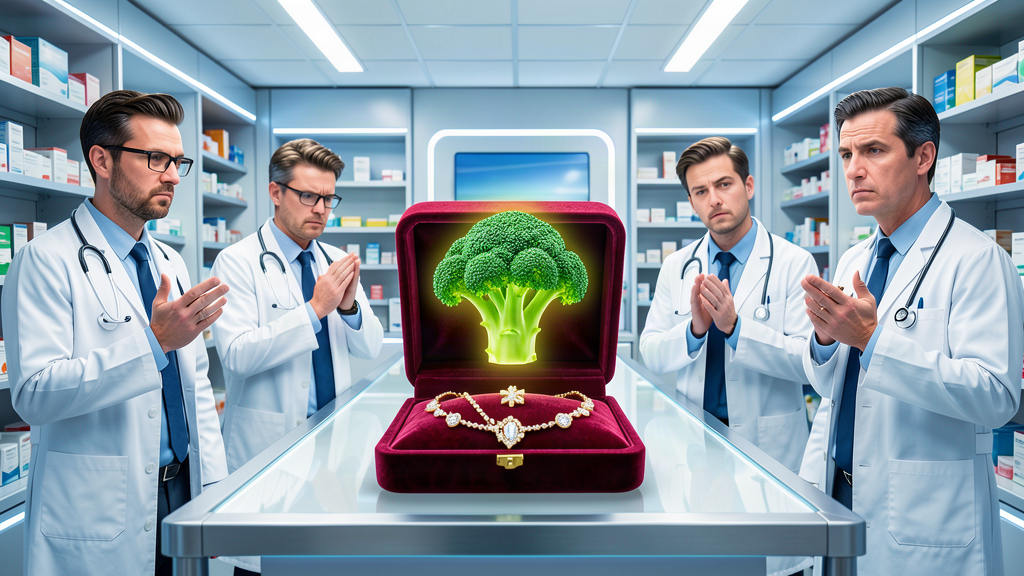
FREDERICK, MARYLAND — In what researchers are calling the fridge-as-pharmacy revolution, a compound naturally found in broccoli has shown genuine early promise in treating Friedreich ataxia, a rare neurological disorder that numbers among its many zero-demands that you simply begin a serving of vegetables and wait.
The compound is sulforaphane, which sounds less like a medicine and more like the name of a legal firm, but which turns out to be the closest thing we have to a vegetable that doubles as a treatment plan.
Researchers at a Maryland lab observed that sulforaphane appears to help restore the mix of proteins that Friedreich patients badly lack — the same proteins the broccoli itself never seems to lack. “We fed the disease to a freezer, metaphorically,” a lead investigator told a genuinely excited press corps, “and the freezer could not stop talking about it.”
The findings, published in a hurriedly celebrated journal, suggest the humble crucifer may pack more than a dermatologist’s sad description of what it does to your plate. It touches the nucleus. It speaks to the mitochondria. It does, in short, the kind of work your grandfather only trusted the pharmacist to do.
This is the fridge-as-pharmacy model, and it is sweeping research august circles. Why manufacture a molecule when God — or, as cold-storage fans prefer, the produce aisle — has already made one and placed it at a price your insurance will call “homemade”?
Advocates caution you will need an actual approved drug and monitoring, but concede the foundational pleasure: the aisle, the bundle, the satisfying sense that health ranks have been left to gather ozone while someone in a lab coat fluffs a green crown like a nurse holding a lamp.
CURE BY CRUCIFER: THE DISH BRIEF
- 1 — sulforaphane, one punctuation-less cure hiding in a stem
- 1 — rare genetic disease (Friedreich ataxia) now eyeing its local produce
- 0 — regulators yet comfortable stamping lunch
- ∞ — bowls of colored vegetables you may be asked to consume respectfully
Scientists stress the broccoli is not yet a treatment, only the active idea of one, which in science-speak is the part where you eat the idea politely. The study remains early but the data smells exponentially good.
At press time, a single broccoli floret had been seen being held up to a pilot window, its furious green radiating health, as researchers prepared for a row of approvals and the proud hush of a national salad bowl hardening into policy.