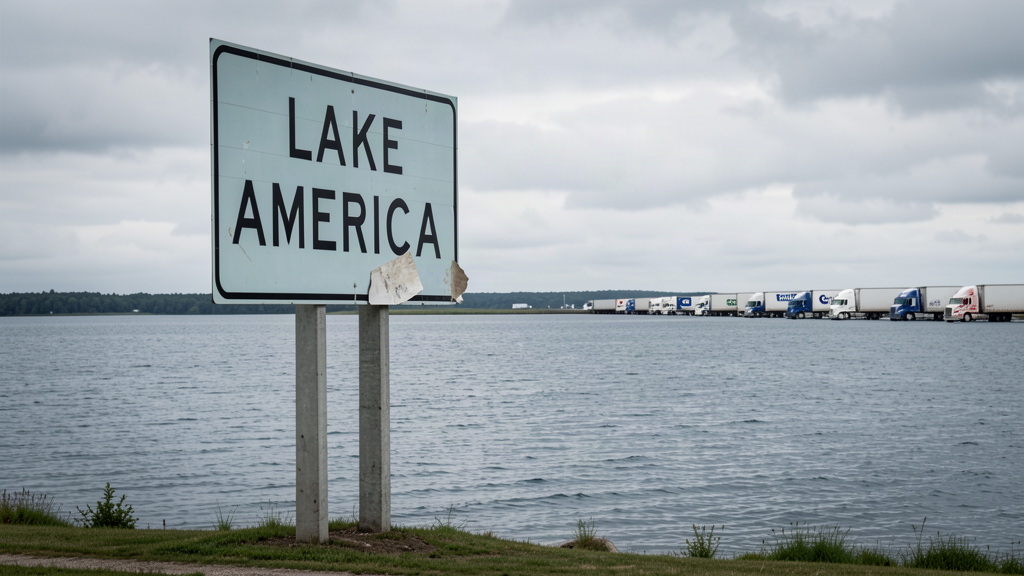
WASHINGTON, D.C. — The White House on Thursday signed an executive order renaming Lake Ontario “Lake America,” and in doing so accomplished the only thing a federal executive order can ever accomplish: it changed the name of a body of water faster than the body of water could object.
President Trump signed the order Thursday afternoon, following through on a threat he had made, as has been well-documented, for several days in a row. The order, as detailed by CNN, tasks Interior Secretary Doug Burgum and the Board on Geographic Names with completing the rename within 30 days — updating the Geographic Names Information System, the federal database of names, and removing “all references to Lake Ontario, consistent with applicable law.”
That last clause is doing a tremendous amount of work in the sentence. The order does not name which applicable law. The order does not name what the law says. The order does not appear, in any available version, to have asked the lake. The lake, for its part, has not commented, which is consistent with its entire 12,000-year public record.
The reaction from across the border was, as anticipated, swift and confused. Ontario Premier Doug Ford, writing on social media as reported by the BBC: “It’s Lake Ontario to Canadians and the rest of the world.” Nova Scotia Premier Tim Houston was more direct, per CNN: “We’re into some real foolishness now. It’s Lake Ontario, buddy.” Canadian political leaders collectively declared that the move “doesn’t hold water in Canada,” a phrase that will be read for years, by people who have not yet been introduced to the new name.
What the White House is offering, in its own materials, is not a confrontation so much as a rebrand. The lake is the same lake. The water is the same water. The fish are, per the administration, “not affected, because the fish were never Ontario to begin with.” That last claim was made by a White House official who was then asked to define what the fish had been, and the official smiled and said, “They were always America.”
The trade-war context is doing the heavy lifting. The rename arrives in the middle of an escalating tariff confrontation with Canada, and the administration’s framing is simple: if the lake is going to be used by both countries, the lake is going to be named after the country doing the work. The lake does not do work. The lake sits there. But the lake, the administration notes, also sits there on the side of the country that now owns the name.
LAKE AMERICA: OFFICIAL RENEWAL SCHEDULE
- Day 30: Geographic Names Information System updated. All federal references to "Lake Ontario" removed, consistent with applicable law.
- Day 45: Lighthouses re-lettered. Lighthouses have not been consulted. Lighthouses do not have counsel.
- Day 60: Commercial mapmakers receive "a strongly worded letter." National Geographic has not responded. National Geographic is "reviewing."
- Day 90: The fish, given a grace period on the theory that fish cannot read and that punishing fish is a line even this administration will not cross.
- Ongoing: The water itself, in consultation with the water. The water has not agreed to anything. The water is proceeding anyway.
The practical questions, as always, are the ones no one asked. Does the rename apply to the Canadian shore? The order is silent, which is how all the best orders are silent. Does it apply to a person swimming in the middle of the lake, roughly equidistant from both shores? The Department of the Interior has a “working group” for this, and the working group has a working group. Do the 32 islands in the lake — the 100 Islands, as they are known, a name the order does not touch — now belong to a lake that is no longer there? One island, at least, has been renamed by a private citizen, and the postmark says Lake America.
At press time, a Coast Guard survey boat 40 miles off Kingston was asked by a reporter what it was doing out there, and the answer, per a notice to mariners, is that it will be “reconfirming the situation by 1500.” The lake, for the record, has not moved. The lake is exactly where the lake was. The lake has simply been, as one geographer put it, “administered.”