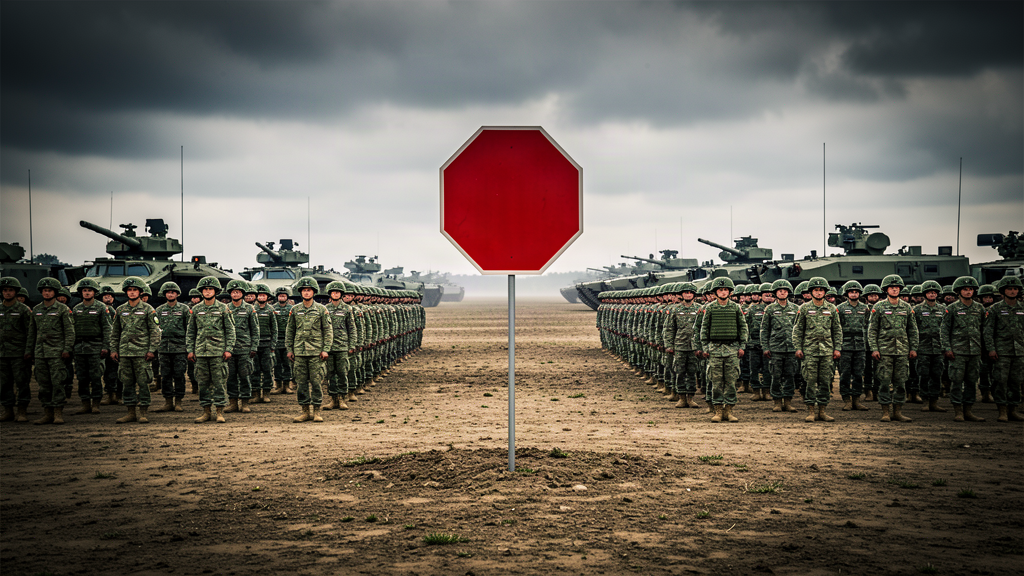
WASHINGTON — President Trump on Sunday ordered the Pentagon to “substantially reduce” the annual joint military exercises with South Korea — the drills that have served as the alliance’s way of telling a certain country on the Korean Peninsula that the United States is still around — and, by his own account, he did it because North Korea has been “unthreatening and respectful.”
The president made the announcement on social media a day before the exercises, known as Ulchi Freedom Shield, were set to begin, and framed the decision as an act of personal diplomacy. The drills, he said, are not only costly but “send a signal that is totally inappropriate and hostile” to North Korea, a country he said has been “unthreatening and respectful” during his time in office, and which he is, in his words, on a “very good” relationship with.
Let us sit with that sentence, because it deserves the treatment. The United States is telling one of its oldest allies to stand down. The reason is that the ally declined to join a war in the Middle East. And the method is to tell the other side — the side the drills exist to deter — that the drills were personally insulting to them. That is not a policy. That is a group chat.
The foreign policy establishment spent Monday describing what the military calls “deterrence” in a way that suggested the concept may have been retired. Leif-Eric Easley, a professor of Korean studies, warned the cuts would “slow the process of South Korea taking on greater responsibility for its own defence, and weaken deterrence against possible conflicts in Asia.” The Hill called the move one that “rattles foreign policy world.” The foreign policy world, for its part, has spent the last 24 hours doing what it does best, which is making the phrase “tit for tat” do work that used to require a treaty.
And the president did, to be fair, give two official reasons: the cost of the drills, and South Korea’s refusal to take part in actions against Iran. The first is the kind of reason a man gives when he has already decided and needs a second reason. The second is the kind of reason that would have made the Founders put down their pens and get a whiskey.
The White House press conference on Monday provided the day’s centerpiece, when a CNN reporter asked whether the reduction was something Kim Jong Un had requested. The president’s response, according to everyone who was there and several people who were not, was to tell the reporter she was being “disrespectful in front of this young man,” that she was a “loud, boisterous person,” and, in the case of CNN, fake news. The young man’s identity has not been established, and the White House has not said whether the young man in question was present, a figurehead, or a concept. We note for the record that a question about the North Korean leader is now officially a question about “this young man,” and that no one in the room appeared to be in a position to clarify which young man.
South Korea’s response, for its part, was the response of a country that has been allied with the United States since 1953 and has just been told to take the weekend off: the nation “recognizes the importance” of the alliance and will “maintain its own readiness.” That is the diplomatic term for “we are going to keep training whether you like it or not,” and we welcome it.
The Pentagon, asked what “substantially reduce” means, said it is “working through the details,” which is the Pentagon’s way of saying it has not been told yet.
WHAT "SUBSTANTIALLY REDUCE" MIGHT MEAN: A NON-EXHAUSTIVE LIST
- Fewer jets. (Confirmed: yes.)
- A shorter schedule. (Plausible: yes.)
- The word "substantially" doing most of the work. (Almost certainly.)
- A meeting between two countries that used to have a meeting. (Not yet.)
At press time, the first reduced Ulchi Freedom Shield was underway with a number of participants the Pentagon described as “appropriate to the circumstances,” a phrase with a 400-year track record of meaning “we don’t know yet.”