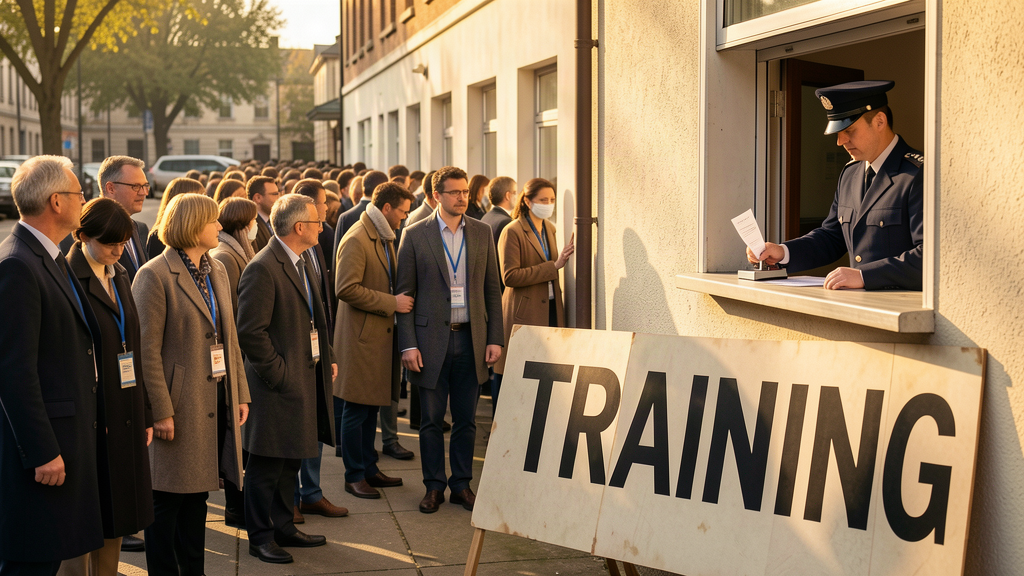
WASHINGTON, D.C. — A few days after a federal judge ruled that Secretary of State Marco Rubio cannot simply instruct consular officers to refuse applicants from 75 countries, the State Department announced a new approach to the problem that, in the interest of fairness, sounds a lot like the old approach with a classroom bolted on.
All immigrant visa interviews at U.S. embassies and consulates worldwide have been suspended while officers undergo what the department calls a “global training initiative” on how to evaluate applicants, with appointments “adjusted to accommodate the training” and no end date in sight, according to reporting on the pause.
The timing is not lost on anyone. Judge Jeannette Vargas, who was appointed by President Biden, vacated the 75-country policy on August 21, ruling that Congress gave individual consular officers the authority to decide visa eligibility case by case, and that the blanket nationality-based outcome exceeded the Secretary’s statutory authority.
The administration’s answer was to keep the goal, upgrade the venue, and add coffee breaks.
A State Department spokesperson said the department “will use its long-standing legal authorities to deem certain applicants ineligible for immigration if they are likely to become a burden on the United States,” but going forward it will do so through comprehensive, standardized, in-person instruction at every post on the planet.
That is not a retreat. That is curriculum.
“This is exactly what the judge asked for, honestly,” said a senior administration adviser who has followed the litigation. “Individualized review. What we did was give every consular officer in the world a masterclass in individualized review. The difference is the catering.”
Applicants with already-scheduled interviews received email notices that their appointments had been rescheduled, with a new date to follow. When.
Brian Simmons, an immigration attorney who has watched a decade of this exact movie, said his clients “spent thousands of dollars and disrupted their lives to attend scheduled interviews, only to have their appointments cancelled at the last minute.”
The department has not published the number of appointments affected, the full training schedule, or a restart date. It has, however, confirmed the spirit of the program.
GLOBAL TRAINING INITIATIVE: CURRICULUM AT A GLANCE
- Module 1: The public charge, from A to Z (12 hours)
- Module 2: Advanced interviewing — "Tell me about your family's savings" (16 hours)
- Module 3: Case studies from posts around the world (24 hours)
- Module 4: Content forthcoming
- Module 5: Content forthcoming
- Passing requirement: 84 percent on the final 200-question quiz; two attempts allowed
- Interviews resume: When appropriate
The White House framed the move as part of its broader America First immigration agenda, which the administration describes as protecting “the meaning and value of American citizenship” and keeping taxpayer-funded benefits from becoming a magnet.
There is a school of thought on the right that the pause is the most responsible thing the department has done in years, and a school of thought on the left that the pause is the least responsible thing, and both schools are currently standing in the same line at the same consulate, which is about as American as it gets.
At press time, the State Department declined to confirm a training timeline but did confirm that officers who score below 84 percent on the final quiz will be required to “retake the module.” The first retake window opens, according to one embassy, when the module is ready.