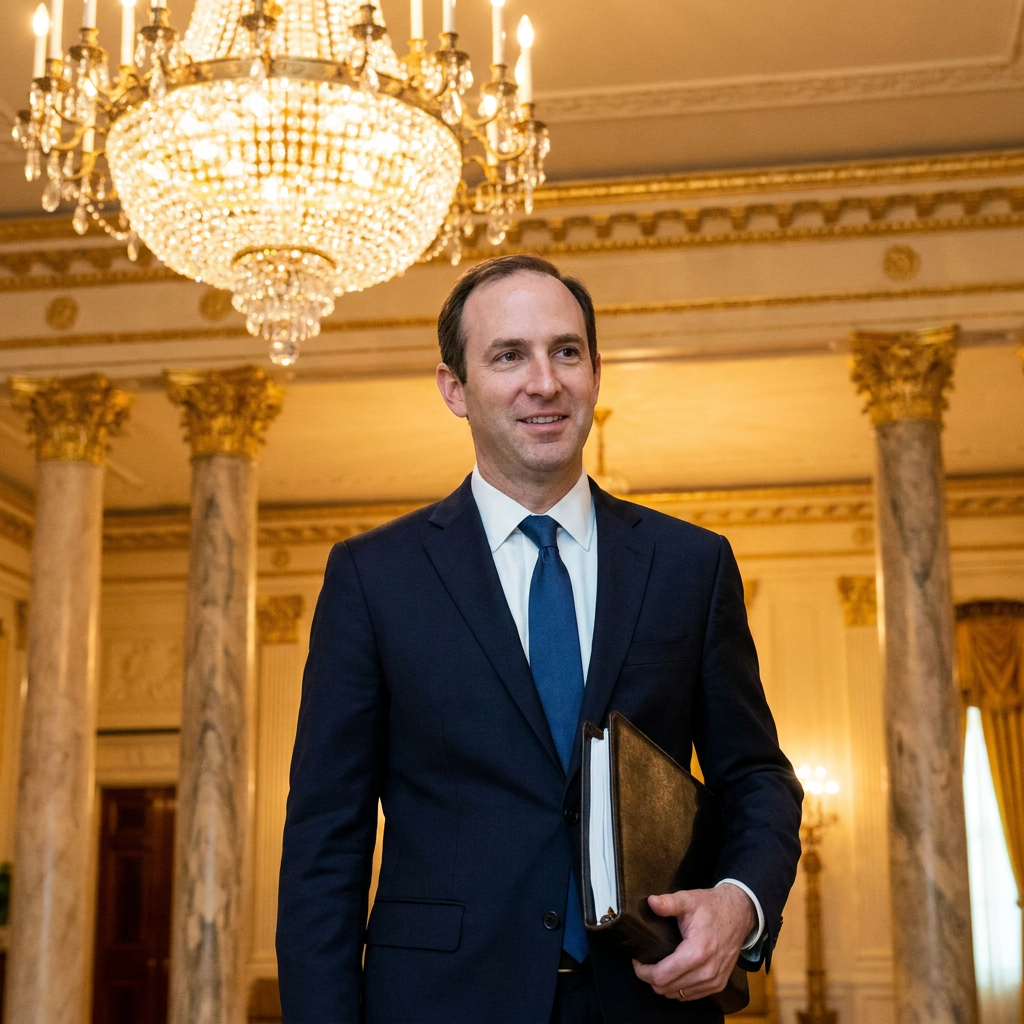
WASHINGTON — President Trump announced Sunday that Will Scharf, the staff secretary whose National Capital Planning Commission helped secure approval for the $400 million White House ballroom project, will become the new White House counsel, replacing David Warrington effective Sept. 1.
It is the latest triumph for a man whose resume now reads like a masterclass in seeing the big picture. Harvard Law School. Assistant U.S. attorney. Personal attorney to the president. And, most importantly, the man who got the ballroom approved.
“Will understands that the law is not about statutes and precedent,” said a senior administration official who asked not to be identified because he was not authorized to talk about how impressive the ballroom is. “The law is about a vision — a 90,000-square-foot, gold-leafed, column-lined vision with seating for 1,400. Everything else is just filing.”
Skeptics have noted that the ballroom project was dealt a setback Friday, when a federal appeals court panel ruled that President Trump cannot unilaterally demolish portions of the White House to build the ballroom without congressional approval. But supporters say this only strengthens Scharf’s credentials.
“Did you see what that court did?” asked one Republican strategist. “They wrote a full appellate opinion about Will’s project. That’s called name recognition in this town. You think the average White House counsel has ever gotten an entire circuit panel to think about him for a weekend? Please.”
Critics also point out that Scharf, a former assistant U.S. attorney who clerked for the Eighth Circuit, has spent his recent White House tenure shuffling paper as staff secretary. Staffers counter that paper-shuffling at the presidential level is simply lawyering with better stationery. “Every executive order, every memo, every pen that touched a veto — Will has seen it all,” said a former colleague. “That’s the kind of hands-on experience you can’t get from a Westlaw subscription.”
The White House has emphasized that the ballroom remains a top priority, with supporters noting that a lawyer who has already fought for the project once will fight for it again — this time with the full authority of the White House counsel’s office, a copy of the appeals court’s opinion, and, sources say, a growing file of creative arguments involving the Take Care Clause and what one aide described as “the inherent ballroom power of the presidency.”
White House aides dismissed suggestions that the timing — a promotion days after a courtroom loss — was unusual. “Losing in court is just winning with extra steps,” one aide explained. “Now Will gets to win the rematch.”
According to a fact sheet distributed to allies, Scharf’s experience translates directly to his new role:
BALLROOM-TO-BENCH SKILLS TRANSFER
- Procurement: Secured approval for a $400 million project with zero prior construction experience
- Litigation: Has now been the subject of a federal appellate ruling — most lawyers go their whole careers without being written about
- Negotiation: Convinced a commission of planners, architects, and historians that demolishing the West Wing for a party space was a security measure
- Jurisprudence: Familiar with the Take Care Clause and the "take the whole ballroom" Clause
- Document review: Has reviewed more paper than any counsel in history, including every single page of the executive calendar
At press time, Scharf was reportedly preparing his first official legal opinion — a 60-page memorandum concluding that the appeals court’s ruling contains a binding conflict with the findings of a structural engineer, three interior decorators, and the president’s own sense of the situation.