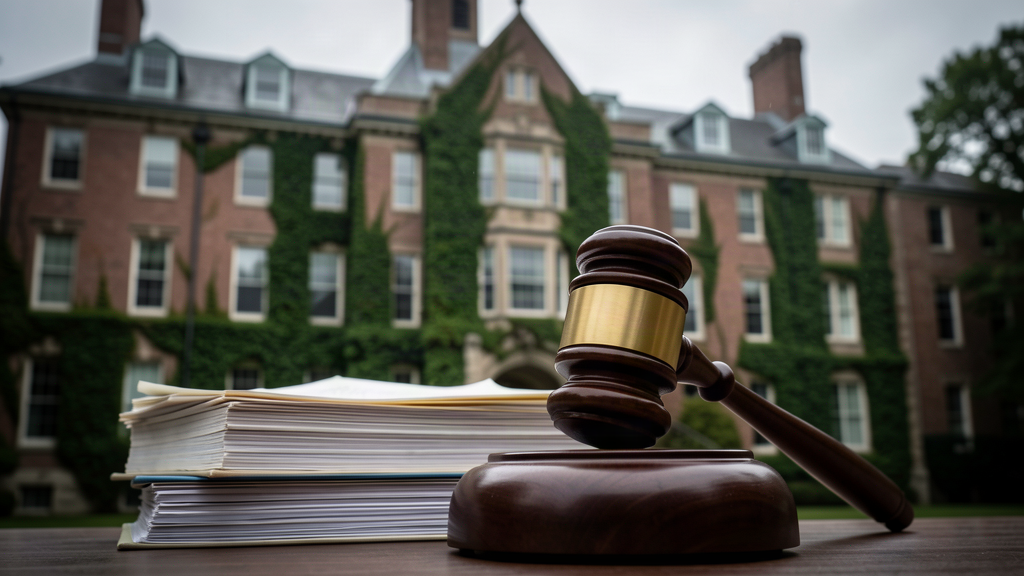
CAMBRIDGE, MA — In a devastating blow to the Justice Department’s effort to recover billions in federal research funding from Harvard University, a federal judge has ruled that the university’s treatment of Jewish students was “too isolated and episodic” to count as an ongoing violation of federal civil rights law.
As any patriot knows, greatness takes consistency. You don’t build an institution like Harvard by doing things halfway. And you don’t tear one down for a handful of incidents spread across an academic year and change — unless you are prepared to demand from the government’s critics the same rigor you would demand of a Fortune 500 compliance department.
U.S. District Judge Richard G. Stearns ruled that the administration failed to prove an ongoing violation of Title VI, pointing out that the lawsuit, filed in March, mostly concerned incidents from the 2023-24 academic year, with a few from March 2025. In other words, Harvard’s alleged failures were simply not sustained enough to matter.
“This is a ruling about timing, not about values,” said one Justice Department official who asked not to be identified because he was not authorized to talk about scheduling. “The judge is essentially telling us: come back when the university shows real commitment. We intend to.”
Harmeet Dhillon, the assistant attorney general for civil rights, said the department disagrees with the ruling and is assessing next steps. That a department of the United States government is now in the position of waiting for an Ivy League university to misbehave more consistently is, frankly, a tribute to our legal system’s devotion to due process.
The administration had argued that Jewish students were “harassed, physically assaulted, stalked, and spat upon” during pro-Palestinian demonstrations in the aftermath of the Oct. 7, 2023, attacks, and sought to recoup billions in research grants awarded since that date.
Harvard, for its part, is overjoyed. University officials note that they have formed a task force, hired a new provost, hired new deans, and reformed discipline policies to be “more consistent, fair and effective.” One dean, speaking on condition of anonymity because he was not authorized to celebrate, offered an unprompted clarification: “Our commitment to our Jewish and Israeli community remains sincere. It is simply, as the court noted, episodic. We believe in quality over quantity.”
THE ONGOING VIOLATION STANDARD: A LEGAL PRIMER
- An isolated incident of discrimination: not a violation.
- A string of incidents over two academic years: also not a violation.
- A violation that is ongoing, unbroken, and sustained: now that's a violation.
- Harvard's strategy: pace yourself. Consistency is for losers.
- DOJ's strategy: a stakeout. Federal attorneys are reportedly prepared to monitor the campus full-time, indefinitely.
Critics of the ruling — and there are a few confused souls who apparently expected the law to protect students rather than institutions — point out that requiring discrimination to be “ongoing” is a strange prerequisite for punishing it. But those critics simply do not understand how American excellence works. In this country, you are not judged by what you do on your worst day. You are judged by whether you do it often enough to be sued about it.
“Some say the ruling rewards universities that keep their bigotry below the legal threshold,” said a senior administration strategist. “Others say the ruling punishes universities for not being thorough. The truth, as always, lies in a third position I just invented: this is a victory for everyone who believes in taking things one day at a time.”
At press time, the Justice Department was reportedly assigning a team of attorneys to monitor Harvard Yard around the clock, in the hope of catching what one official called “a real, sustained, ongoing pattern of behavior” — and, failing that, to at least document a very long tailgate.