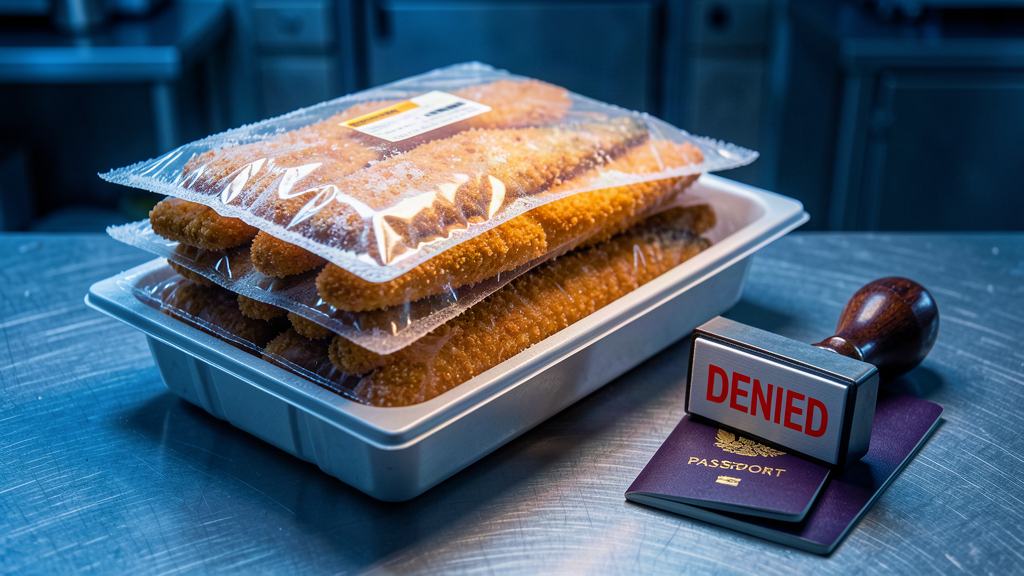
CAROL STREAM, ILL. — Somewhere in America, right now, there is a freezer full of breaded fish that has committed no crime other than being born in the wrong place.
The USDA has announced that Shan Distribution Network, Inc., is recalling approximately 5,084 pounds of frozen breaded swai fillets and sticks because they were produced in the United Arab Emirates — a country that is not eligible to export catfish to the United States. That’s right: not because the fish is unsafe, not because the fish is spoiled, not because the fish did anything wrong. The fish is simply from the wrong country. The fish is, in the eyes of the federal government, undocumented.
“Swai is not about taste,” said Gerald Mott, 52, a self-described swai loyalist who was reached at his freezer, where he keeps a backup bag for emergencies. “Swai is about $2.49 a pound and a complete absence of questions. I don’t ask where the fish is from, and the fish doesn’t ask about my life choices. That’s the deal. That’s the whole deal.”
The distinction, federal officials explain, comes down to the Siluriformes import framework — a regulatory regime so comprehensive that it governs not only what catfish can enter the country, but where they can be born, raised, processed, and breaded. The United Arab Emirates, it turns out, is on the list of countries not eligible to export catfish to the United States. It is, presumably, on the list of countries eligible to export other things — dates, for instance, and, according to one customs official, “a very good airline” — but catfish is where the line is drawn.
“People don’t understand the catfish export eligibility framework,” said a customs inspector who asked not to be named, on the grounds that his colleagues would never let him hear the end of it. “It is one of the most important frameworks in international food law. I say that with a straight face. The fish, however, was not straight-faced. The fish was breaded. That is the most important part.”
The recall has left swai enthusiasts in a state of quiet panic. At one Midwestern supermarket, shoppers were seen checking the country of origin labels on frozen fish with a suspicion normally reserved for used cars. “I bought three bags last week,” said one shopper, who asked to be identified only as a person who has made mistakes. “I ate one. I’m pretty sure it was fine. I’m pretty sure it was from Thailand. I’m pretty sure. Please don’t check.”
SWAI: WHAT WE KNOW
- What is swai? A fish. Probably. Scientists are still working on it.
- Other name for swai: "The fish that makes tilapia look fancy."
- Why was it recalled? Born in the UAE. A country eligible to export dates, airlines, and confidence, but not catfish.
- Is the fish dangerous? The fish was breaded, frozen, and mostly a vessel for tartar sauce. The fish is fine. The paperwork is not.
- What happens to the 5,084 pounds? The fish has been placed in a holding facility pending a determination of its country of origin, which it has reportedly refused to discuss without a lawyer.
In the meantime, federal officials stress that consumers who purchased the recalled swai should return it to the place of purchase for a full refund — a process that requires, naturally, filling out a form, signing a form, and confirming, on a separate form, that the fish you are returning is the fish you purchased, which, for many swai loyalists, will be the first time they have ever had to account for their fish at all.
At press time, the 5,084 pounds of breaded swai had reportedly been offered asylum by a neighboring freezer, which has yet to receive a response, as the fish, sources say, has gone quiet, which is either a good sign or a very bad one.