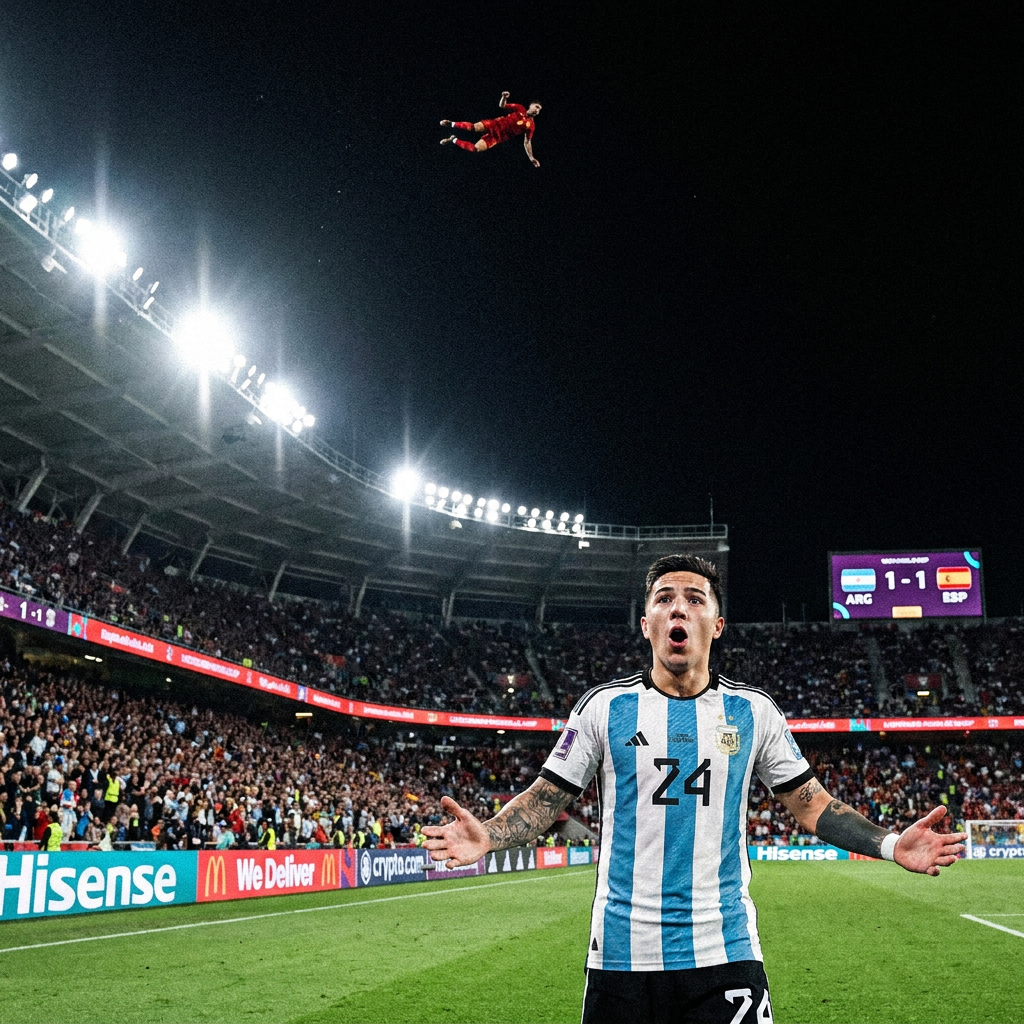
EAST RUTHERFORD, NJ — Let’s start with what actually happened at MetLife Stadium on Sunday night, because in all the controversy, nobody is talking about the single most important fact of the 2026 World Cup final: a man went to space.
Spain’s Pau Cubarsí did not get fouled. He achieved liftoff. Chasing a clearance near midfield in the 93rd minute, Argentina’s Enzo Fernández arrived at roughly the same zip code as the ball, and the Spanish defender — who had already cleared it, by the way — launched vertically into the night sky with the kind of trajectory normally reserved for NASA test flights. Witnesses described him as “fully horizontal” at an altitude that concerned at least one passing aircraft. Video review confirmed the flight path, if not the physics.
The FAA has not commented. Neither has NASA, although sources say the agency was “intrigued.”
Here is where the story becomes genuinely baffling: the man responsible for the launch had absolutely no idea why anyone was upset. Enzo Fernández stood over the point of departure, arms spread wide, mouth open, waving at the referee and requesting a video review with the pure, unshakeable confidence of a man who had just done absolutely nothing. There is a version of events where Cubarsí comes back down; Enzo’s face suggests he is still waiting for that to happen.
“I’ve watched the replay forty times,” said former referee analyst Dale Hartley. “Cubarsí is up there for what feels like a full minute. He clears the ball, he goes airborne, he achieves escape velocity, and at no point does Enzo appear to register that any of this is connected to him. Look at his face. That’s not a man who’s guilty. That’s a man who’s wondering why everyone stopped playing.”
The sequence leading to the launch was, by all accounts, ordinary. Fernández had been booked earlier for asking the referee a question about a non-call — dissent, they called it, which in this sport apparently means “requesting clarification.” Unbowed, he continued asking questions of the universe, including “why?” and “what did I do?” as he was escorted toward the tunnel. The referee’s decision stood, and Spain went on to win 1-0 in extra time.
In the aftermath, the internet has divided into two camps: those who believe Cubarsí was fouled, and those who simply want the trajectory data. A petition demanding a replay has gathered 82,000 signatures, though a competing petition demanding Cubarsí be granted frequent flyer miles has nearly as many.
THE FLIGHT OF PAU CUBARSÍ: OFFICIAL MEASUREMENTS
- Altitude reached: Estimates range from 30 feet to "somewhere over New Jersey"
- Time airborne: Long enough for at least three replays and one heartfelt apology
- Trajectory: Horizontal, with a slight tailwind, reminiscent of a paper airplane with ambitions
- Landing zone: Unconfirmed; reports of a red jersey touching down near the Lincoln Tunnel were never verified
- Enzo's reaction: Confusion. Total, immovable, sincere confusion
- Enzo, still, at press time: Confusion
At press time, Enzo Fernández was reportedly still standing at the center circle, arms spread, waiting for someone to explain what happened. Pau Cubarsí, meanwhile, had reportedly landed and rejoined his teammates, who gave him a round of applause for the best vertical leap in World Cup history. The referee, for his part, has been invited to speak at next year’s International Conference on Airspace Management, where his ability to detect objects in flight will be studied closely.
Spain has the trophy. Cubarsí has the altitude record. And Enzo Fernández has a question he will be asking for the rest of his life: what did I do?