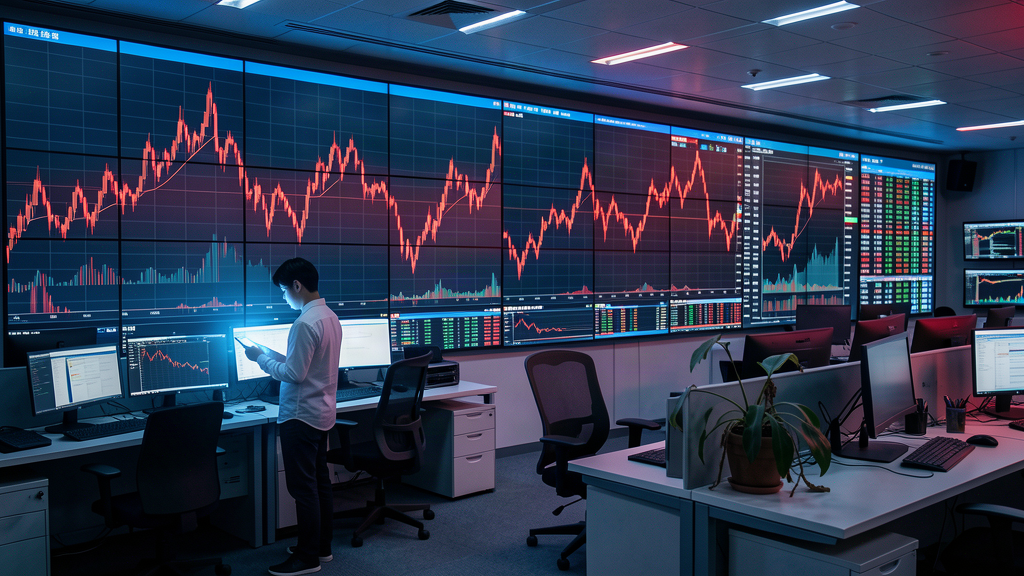
SEOUL — The South Korean stock market, already renowned as the world’s most volatile index, fell 5.8 percent on Wednesday to close at 6,471.17, briefly tripping the circuit breaker in a session that was, by the account of everyone who trades it, less a market than a roller coaster with a waiting list.
The index, which more than doubled from the start of the year to clear 9,000 points in mid-June before plunging to 5,500 within weeks, has spent the past month performing what BNY described as “one of the sharpest corrections” in its history — a phrase the bank chose with the care of a man describing a fall to an insurance company. Wednesday’s drop followed overnight losses on Wall Street, as rising bond yields and oil prices weighed on the technology stocks that do, in effect, all of the heavy lifting in the Kospi. SK Hynix fell 9 percent, Samsung fell 7, Kioxia fell 10, and Japan’s Nikkei, which has spent the past several weeks moving in lockstep with its neighbor, fell 3.2 percent in solidarity.
The market’s answer to the selling, delivered the same morning, was a piece of corporate theater with a price tag. SK Hynix, the chipmaker that is, in the global AI trade, roughly the equivalent of the last man standing in a burning building, announced on Wednesday that it will buy back and retire 40 trillion won — about $28.6 billion — of its own shares, a record, and, in the words of one coverage, a move “to calm investors worried about the durability of AI spending.” For context, the company raised roughly $26.5 billion from American investors in July by selling American investors new shares. The shares it sold in July are the shares it is now buying back. This is not a capital structure. This is a game of musical chairs with a corporate logo.
The human edition of the story, reported by the BBC, is the part that does not round nicely. Yongjoon Kim, a bank worker, lost 20 million won — about $14,000 — on tech stocks in July alone. The money, he explained, was meant to help buy a home, as he and his fiancée are getting married later this year. “It’s going to sting,” he said, “and I’m going to have to work really hard to make up for this.” His fiancée, Gaeon Lee, has a more complicated position on the market than most spouses do: she is optimistic about the recovery and worried about him, in that order, because the monitoring has taken a toll.
Others did not round either. Chanyong Park, who works in marketing, saw his U.S.-listed Nvidia shares rise by more than 1,000 percent and put most of the profit into SK Hynix, which has since lost him about $10,000. He was planning to quit his job around October to start a business. “It doesn’t always feel like movements are driven by rational reasons,” he said. “Sometimes it still feels a lot like gambling.” Youngji Park, who went “all in” on Samsung at a peak of 45 million won, described the decline as “gut-wrenching” and said, in the words of a man who has found his new favorite sentence, “I feel like a fool for trusting the Korean stock market.”
On the internet, where the market’s fans gather, the consensus was roughly as follows: Korean retail investors bought the top on leverage, and the institutions are having a field day. One of the better formulations, from a thread that has since been the subject of its own moderation, was that the bubble has not popped; the institutions are simply taking profits and creating “a new entry level for the next round,” which is the financial term for a second wave.
THE KOSPI, IN ONE CHART
- Start of year: baseline
- Mid-June: above 9,000 (doubled)
- July: 5,500 (the plunge)
- This week: 6,800, then 6,471.17 (Wednesday, -5.8%, circuit breaker)
- SK Hynix: -9% in Seoul, +8% in U.S. overnight trading on the buyback news
- The buyback: 40 trillion won, roughly $28.6 billion, a record
The advice, from both the banks and the people in the BBC, has been identical and has been identical for a decade: do not put everything in one basket. The basket, as noted, is the one that is on fire.
At press time, the Nikkei had closed at its lowest in nearly two weeks, the circuit breaker had not yet been formally discussed, and SK Hynix had not responded to a request for comment on the musical chairs.