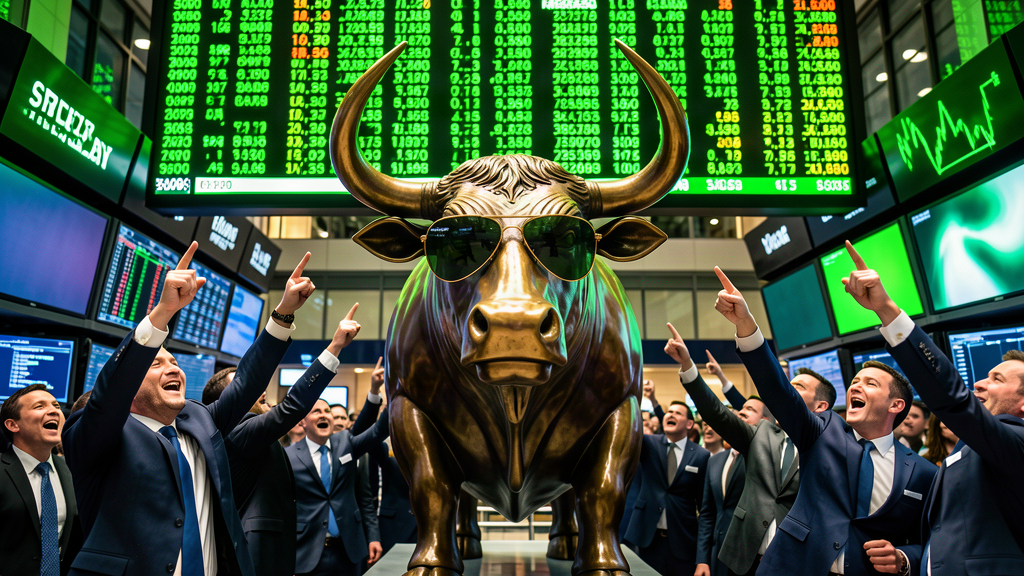
NEW YORK — For decades, investors have tried to predict the stock market using earnings reports, economic data, and sophisticated models. This year, they have found something better: a market that predicts the market.
Traders on the prediction platform Kalshi now see about a 66% chance that the S&P 500 hits 8,000 before the end of 2026, after the index climbed to record highs in a four-day, 5% rally. To the uninitiated, 66% sounds like a probability. To anyone who has spent a career in markets, 66% sounds like a guarantee, plus 16 points of bonus.
The beauty of prediction markets is that they remove all the noise. No more parsing Federal Reserve statements. No more reading earnings calls. No more listening to analysts say “it depends” for forty-five minutes. Instead, you put a dollar down and let the collective wisdom of people who bet on things tell you what is going to happen. One dollar, one vote. And the people have voted: up.
Some skeptics have pointed out that prediction markets are, technically, a form of gambling. These are the same people who said the S&P would never hit 7,000, and look at us now: walking around with a 7,700 handle like it is nothing, buying avocados, feeling good about ourselves. The skeptics are not betting. The skeptics are not winning. The skeptics are the ones asking questions while the rest of us are pointing at the number.
The path to 8,000, according to the crystal ball, is straightforward. Fundstrat’s Tom Lee — a man whose name sounds like a bull — has called for 8,000 as soon as this month, powered by earnings and tech momentum. The Kalshi crowd agrees, with odds that have been described as “high” by people who understand numbers and “low” by people who do not.
There is, of course, a 34% chance the market does not hit 8,000. Let us be clear about what that means: 34% of the time, the market is wrong. We do not talk about that 34%. We are not a 34% kind of publication. We are a 66% kind of publication, and 66% is a sure thing.
THE ROAD TO 8,000: OFFICIAL CHECKPOINTS
- 7,600: Where we were. Ancient history.
- 7,700: Where we are. The present. Lovely weather.
- 7,800: The stretch. This is where the market begins to believe in itself.
- 7,900: The nervous lap. Analysts will begin saying "this feels high" — ignore them, they said the same thing at 7,000.
- 8,000: The finish line. Confetti, champagne, and immediately a new market on whether it hits 8,500, which traders will price at 66% out of tradition.
The market has spoken, and the market about the market agrees with the market. It is the most democratic thing Wall Street has ever done: betting on itself, in public, and winning.
At press time, Kalshi had opened a new market on whether Kalshi is a reliable predictor of the market, and traders had priced a 74% chance that it is 66% right.