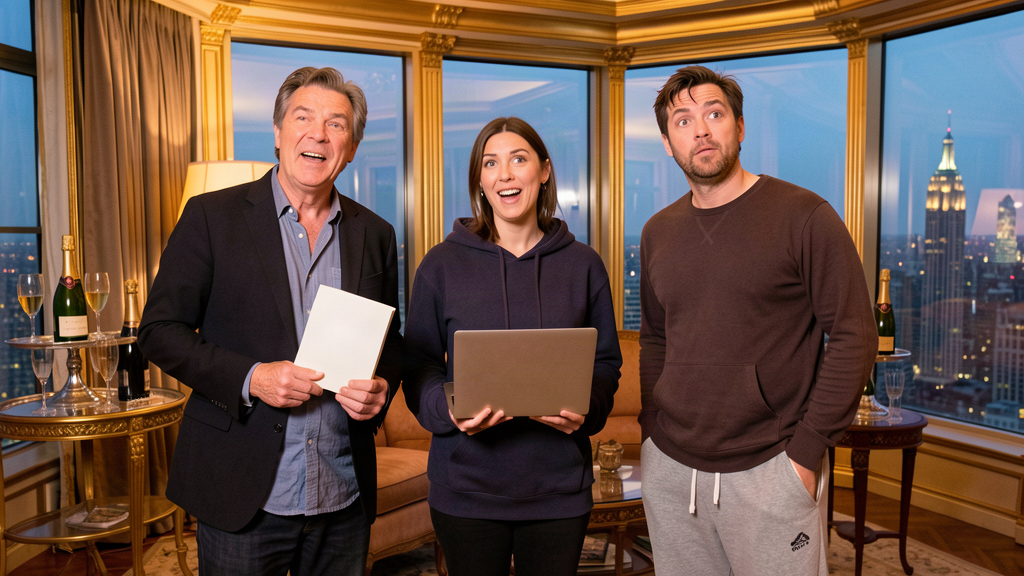
NEW YORK — The artificial intelligence boom has produced its most diverse class yet: 19 new billionaires worth a combined $59 billion, according to Bloomberg — a group that includes a published poet, a founder helping catalog associates of the late financier Jeffrey Epstein, at least three people with no college degrees, and one individual who pleaded guilty to a felony.
Market analysts say the eclectic roster is proof that the AI economy has finally democratized wealth.
“This is the American dream in its purest form,” said Gerald Vance, a wealth strategist who advises several of the new billionaires. “You don’t need a degree. You don’t need a clean record. You just need a model that can do the work of 40 paralegals and a willingness to tell investors it’s the future of everything.”
The new billionaires represent a sharp departure from the first wave of AI fortunes, which were built on data centers, chips, and large language models. The newcomers are applying AI to law, healthcare, customer service, and software development — industries where, as Vance put it, “the paperwork was just sitting there, waiting to be automated.”
Observers have noted that the poet-billionaire’s literary background gave him a unique edge in the AI industry. “Most founders pitch with slide decks,” said one venture capitalist who asked to remain anonymous. “This one pitched with a villanelle about backpropagation. When he got to the part about the loss function being a ‘lover’s quarrel with the truth,’ we were already wiring the money.”
The founder assisting with the Epstein associate catalog has reportedly found his AI work and his archival work increasingly complementary. “Both are essentially sorting large data sets for people who would rather not think about what’s in them,” explained a colleague. “It’s the same skill set. The market recognized that.”
Even the billionaire with the felony conviction has become something of an inspiration. “Look, everyone makes mistakes,” said Vance. “His mistake just happened to be the kind that a background-check algorithm flags. And who better to understand the flaws of AI-driven background checks than someone who failed one? It’s literally product development.”
The new billionaires have reportedly begun buying the usual trappings of extreme wealth — private islands, decommissioned aircraft carriers, and, in one case, a small country’s entire mint — while continuing to dress like people who shop at the same gas station as everyone else.
“Money can’t buy class,” one of the new billionaires told reporters, “but it can buy a foundation that hires people to describe you as classy, which is basically the same thing.”
THE 2026 AI BILLIONAIRE CLASS: A PROFILE
- Total wealth: $59 billion — enough to buy every poetry collection ever printed, with change for a chip fab
- Published poets: 1 (technically also a founder, but the poetry is what closed the round)
- Epstein-associate catalogers: 1 (the world's most unusual synergy)
- College dropouts: at least 3 (who needs a degree when you have a training run?)
- Felony convictions: 1 (now serving a life sentence as a billionaire)
- Average bedtime: unknown, but presumably whenever the model finished fine-tuning
At press time, the poet-billionaire was reportedly at work on his next collection, a sonnet sequence titled “Ode to a Compute Cluster,” which investors have already pre-ordered at $2,000 a copy.