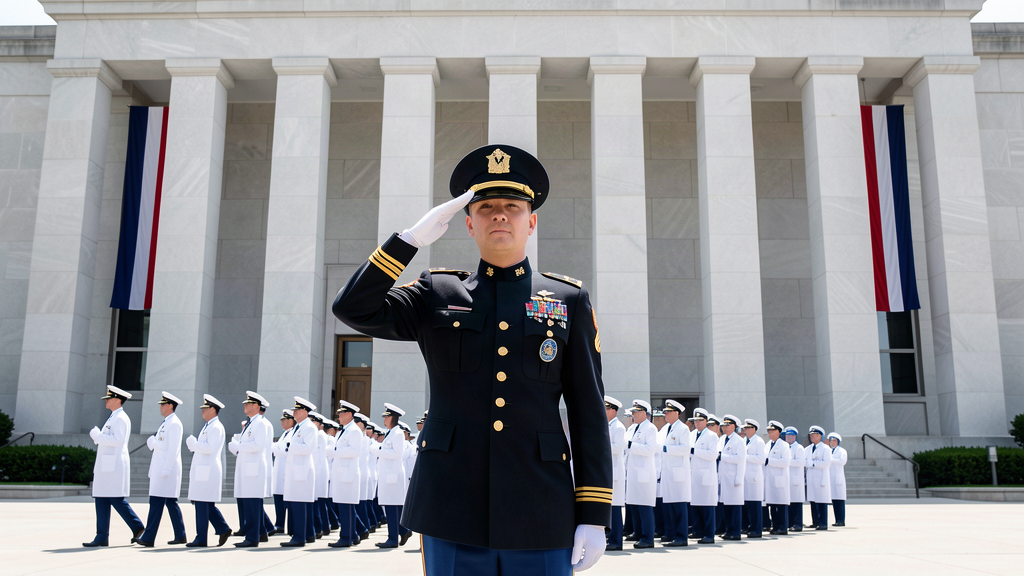
ATLANTA — The Senate confirmed Dr. Erica Schwartz as director of the Centers for Disease Control and Prevention on Wednesday by a 51-44 vote, ending a leadership vacuum that lasted nearly a year, and the agency is finally in the hands of someone who understands the first rule of public health: someone gives the orders, everyone else salutes.
Dr. Schwartz brings impeccable credentials for the job. She is a retired Coast Guard officer and former deputy surgeon general — a background that, until now, the CDC has conspicuously lacked. The agency has spent decades staffed by epidemiologists, virologists, and other people who think for themselves, and look where that got us: an agency beleaguered by political meddling and low morale, which is what happens when an institution forgets that it is an instrument of policy, not a debating society.
Some in the public health community have expressed concern about political interference in the agency’s work. They misunderstand the situation entirely. A ship does not get “politically interfered” with when it receives new sailing orders; it gets directed. The CDC has spent a year without a captain, drifting on momentum like a cutter with a very good autopilot. Now it has a commanding officer, and the difference will be felt immediately: questions will be answered, briefings will be brief, and the science will be informed — in the most respectful sense of the word — of what it is expected to find.
Critics note that Dr. Schwartz’s military background may not translate to an agency whose workforce is accustomed to, shall we say, intellectual autonomy. To which the answer is: good. The CDC is not a university. It is a public health agency, and public health is a command function. When Washington says “march,” Atlanta marches. When Washington says “the data shows,” the data shows. This is how a healthy agency operates, and anyone who disagrees is welcome to file a report — in triplicate, on a clipboard, at attention.
THE CDC'S NEW CHAIN OF COMMAND
- Director: Dr. Erica Schwartz (confirmed, 51-44). Issues orders.
- Deputy directors: Will be informed of the orders, usually shortly after the press release.
- Scientists: Will execute the orders, while maintaining the outward appearance of having designed them.
- Americans: Will be told what to do, in the friendliest possible tone, at the next scheduled briefing.
- Autopilot: Retired. Decommissioned. Its service during the year without a director has been noted and will not be mentioned again.
The year without a director, viewed properly, was not a failure of governance but a triumph of it. The CDC ran, the vaccines shipped, the reports were filed, and no one was in charge to make anyone panic. Americans were never safer than when no one was telling them to be scared. Now, with a director who understands chains of command, they can look forward to being told what to be scared of — and, more importantly, when to stop.
At press time, the CDC’s Atlanta campus had reportedly installed new signage reading “SILENCE IS A PUBLIC HEALTH MEASURE,” and scientists were practicing standing at attention whenever the director’s footsteps were heard in the hallway.